
6.1 Introduction
Life cycle costing is the heart of Asset Management. Knowing exactly how much and what type of maintenance to do on an asset during its life and the correct point to replace the asset would optimize operational and capital expenditures. If you knew this information for each and every asset in your utility, you would know that every dollar spent was absolutely necessary and was being spent at the right time for the right reason. Consider a pump installed in June 1998. Assume you knew that the pump would fail completely in June 2012. You could replace the pump in May 2012. This would use the maximum life of the pump while allowing you to replace it before it became an emergency. We can add another dimension to the analysis by considering maintenance activities. What if you knew exactly what maintenance needed to be done, no more, no less, to have the pump last until 2012? You would need to perform only those particular activities on the pump to achieve its maximum life.
In theory, then, life cycle costing is relatively simple: do only as much maintenance as necessary to get the maximum asset life and replace the asset right before it fails. Unfortunately, the reality of life cycle costing is a bit more complex. It is almost impossible to predict with certainty when an asset is going to fail and it can be difficult to determine exactly how much and what type of maintenance is optimal for each asset.
The Holy Grail of Asset Management is being able to understand when assets are going to fail.
—Kevin Campanella, Columbus, OH
This approach is used all the time in the case of vehicles, even though we might not think of it in these terms. The types of parts replaced on a car before they fail are those components that carry a high risk of catastrophic failure – the brakes, the timing belt, the tires. The parts that are allowed to fail are those that carry a low risk – the radio, the automatic door locks, the cup holders. Medium risk components have the potential to leave you stranded on the side of the road, but probably don’t put your life at risk. These assets are parts like the water pump or radiator hoses. These assets may be allowed to fail or may be replaced before failure, depending on the owner’s risk tolerance. The maintenance activities done on a car are also related to risk. Since changing the oil keeps the engine in working condition, it is done routinely. Very little maintenance, if any, is done on low risk assets in the car. It is unlikely that anything will be done to maintain parts like the radio or door locks. As in the car example, risk is the main factor that will help utilities make decisions on water and wastewater assets for both operation and maintenance and capital expenses.
6.2 Life Cycle Cost Components
In order to improve decisions regarding the management of assets, it is necessary to know the costs of the various components of the life cycle of an individual asset. These costs include:
- initial cost of installation
- operations and maintenance expenses
- repairs costs
- rehabilitation costs
- disposal cost
- legal, environmental, or social costs
At the beginning of an Asset Management program, it is often difficult to find historical cost information for individual assets. Instead, information is usually in an aggregate form. The utility may know total expenditures for operations and maintenance, but not how much of that cost was spent on a particular pump or well or blower. The lack of this type of specific information makes it more difficult to determine the optimal time to replace assets. If you don’t know that of the $40,000 you spent on O&M at the wastewater plant, $5,000 was spent maintaining a clarifier drive this year and an additional $3,000 the prior year on the same drive, you won’t be able to see that it would be more cost effective to buy a new drive at $7,000 than continuing to maintain the old asset.
Aggregate data also makes it harder to determine the overall quality of the utility. For example, suppose maintenance costs are $70,000 per year for a water utility. It would be helpful to know if that cost is uniformly spread out between field assets (pipe, valves, meters) and plant assets (wells, treatment, storage) or whether a single asset or asset class makes up most of that cost. If costs are spread across asset classes such as the following:
- $10,000 on pipe repair and maintenance
- $5,000 on meter and service line replacement
- $20,000 on well maintenance
- $15,000 on treatment related expenses
- $15,000 on storage tank maintenance
- $5,000 on fire hydrant repair and replacement
The utility can see that no one asset class accounts for most of the expenditures. However, if the costs of the $70,000 are distributed in the following way:
- $60,000 on pipe repair and maintenance
- $5,000 on meter and service line replacement
- $2,000 on well maintenance
- $1,000 on treatment related expenses
- $1,000 on storage tank maintenance
- $1,000 on fire hydrant repair and replacement
It is clear that the bulk of the costs are related to one asset class, pipes. In this latter case, the information shows that the utility needs to spend time and effort evaluating pipe to determine why costs are so high in this area compared to the rest of the operation. Addressing pipe issues might significantly decrease the overall cost of operating and maintaining the utility. Even though total expenditures were the same in both examples, the profile of expenditures presents a very different view of what should be done to address the costs.
A deeper analysis can provide even more information about how to address operation and maintenance expenditures. If you take one particular asset class, such as water pipe, and look more closely at how the costs break down between types of pipe, more information can be obtained to aid in decision-making.
In the second example, total pipe expenditures were $60,000 and these expenditures accounted for most of the total cost of operation and maintenance. Further examination of these costs can help to determine which specific assets are driving this cost. Suppose the costs break down as follows:
- Cast Iron pipe <12 inches $40,000
- Cast Iron pipe >12 inches $5,000
- PVC Pipe <12 inches $5,000
- PVC Pipe >12 inches $2,000
- Asbestos Cement (AC) Pipe <12 inches $7,000
- AC Pipe >12 inches $1,000
This type of breakdown would show that cast iron pipe less than 12 inches has the highest expenditures. Further examination of all cast iron pipe that is less than 12 inches would reveal which pieces of cast iron pipe were the most problematic. This data could be examined based on location, age, or some other method. For example, if the pipe was examined based on the decade of installation, the data might look similar to the following:
Install Date
1930s $2,000
1940s $5,000
1950s $20,000
1960s $3,000
1970s $5,000
1980s $5,000
This data indicates that the majority of the problem is in cast iron pipe installed in the 1950s. Perhaps this pipe was not manufactured well or was installed incorrectly or was installed in an area with harsh soil conditions.
This type of detailed analysis of operational data is only possible if data is collected on an individual asset basis or at least by asset class. The more detailed the data, the more advanced and detailed the analysis of costs can be.
This type of data collection will be easier if the data is stored electronically, but data on work orders can also be kept on paper. If the total time for repairs, parts used, and personnel and vehicles involved are kept on the work order, along with information regarding the specific asset on which the work was performed, an estimate can be made of the cost for each type of activity completed on the asset. The work orders can then be sorted by asset and associated asset costs can be tracked. The work orders can also be sorted by asset class (i.e., pipe, hydrants, wells) to determine costs by class. If the utility has very few assets and a limited number of work orders per year, this method can work well. The more assets and work orders you have, the more important it is to keep an electronic version of the data or at least examine the data more frequently to prevent data review from being overwhelming.
Beyond operation and maintenance costs, there are other types of cost data to collect on assets: initial capital cost, costs related to energy use, repair costs not included on work orders, and any other costs associated with the asset (environmental, social, legal). Initial capital cost can be obtained at the time the asset was installed, or the cost information may come from historical records. If no other data is available costs can be estimated. Costs related to energy can be obtained from estimates of energy use as discussed in Chapter 3. The Energy Inventory forms in Appendix A can also be used for this purpose.
Records of all of these costs should be kept on the individual assets in the most sophisticated system available to the utility, be it hard copy or electronic. The more asset-specific the cost data is, the easier it will be to make good decisions on the management of the assets.
6 .3 Operation and Maintenance Costs
The basic functions of keeping a water or wastewater facility running fall under the category of operation and maintenance. These two types of actions are often lumped together as one, but in this section, they will be separated into two distinct activities.
Operations, or operational activities, can be classified into three categories: standard operating procedures, alternate operating procedures, and emergency operating procedures. During the normal course of operations of a water or wastewater facility, standard operating procedures should be used. Standard operating procedures represent those activities that operators perform on a routine basis to keep the plant functional and to ensure that all permit conditions or regulatory requirements are met. These activities include opening and closing valves, turning on and off pumps, filling chemical tanks, taking chlorine residual readings, conducting a jar test, and putting fuel in vehicles.
Standard operating procedures will be used most of the time. However, conditions may change. Perhaps a piece of equipment is taken off line for maintenance or repair or for scheduled shut-downs. Under these conditions, the utility should follow alternative operating procedures. When severe conditions occur, such as natural disasters (flooding, tornadoes, fire) or the sudden failure of a critical asset, the utility needs to follow emergency operating procedures.
The key to efficient operations, whether standard, alternate, or emergency, is to ensure that all personnel are familiar with the procedures. Standard and alternate operating procedures should be captured in an operations and maintenance manual. For a small utility, the manual does not need to be lengthy or excessively detailed. It needs to clearly state what procedures should be followed during normal conditions and how those procedures might be modified in circumstances that call for alternate operating procedures, and it should specify the conditions that require alternate operating procedures. The document should be in a format that is easy to understand, and, above all, should be available to utility personnel. The document should be easy to modify if new procedures are adopted or conditions change.
Emergency procedures can be included in the operations and maintenance manual as a separate section or they can be specified in a special emergency procedures document. These procedures must be kept in an accessible place at all times – a place that will be available to any employee during an emergency. It is a good idea for emergency procedures to be kept in multiple places and in hard copy to ensure accessibility, including in the event of a power failure preventing access to electronic files. Emergency procedures should be coordinated – in advance – with first responder personnel, such as police, fire, hazardous materials response teams, and medical facilities. The emergency procedures should consider all types of potential emergencies at the facility and specify responses to each of these emergencies. Responses should also be practiced in advance to ensure that everyone knows what actions to take, who to call, and how to coordinate with other agencies. EPA has a free tool called Tabletop Exercise Tool for Water Systems, that can be used to practice an emergency scenario. The tool also includes many resources to assist utilities with emergency preparedness procedures and planning.
Maintenance involves those activities that help keep the assets in good working order so that it will operate smoothly. These activities include such things as: changing the oil, flushing water lines, cleaning out a sewer, and lubricating moving parts. Maintenance falls into the broad categories listed below.
- Routine Maintenance
- Planned Maintenance
- Preventative Maintenance
- Warranty-Related Maintenance
- Corrective Maintenance
Routine maintenance represents those activities done on a regular schedule, such as quarterly oil changes or monthly lubrication. These activities are necessary to ensure that the asset will perform properly and can be performed with minimal to no impact on the utility operations.
Planned maintenance is any work that is done on the asset in a planned and predictive way, rather than as a response to a failure or crisis. An example of this type of activity is a planned sewer cleaning program. The utility may decide to clean 1 mile of sewer every month, and a plan can be developed to move through the sewer utility to get this work performed.
Preventative maintenance is similar to planned maintenance, but it involves actions specifically taken to prevent a failure. For example, if the utility examines a sewer with a camera and it shows significant corrosion of a concrete pipe, the utility may wish to add a chemical to reduce sewer gas build up. Another example is a pump that is showing signs of wear in the bearings. The utility can replace the bearings before they fail so that the work may be performed when it is advantageous for the utility (e.g., during business hours, when an operator is on duty, and when spare parts can be ordered ahead of time).
Warranty-related maintenance is any action required by a manufacturer to ensure that the warranty remains in effect. If a manufacturer’s warranty on a particular asset requires specific maintenance, this maintenance needs to be completed on the appropriate schedule and documented to make sure the warranty is not voided.
Corrective maintenance is the work performed after an asset fails in some way. It might be a small failure that requires very little effort to fix or it might be a major failure. A utility should strive to minimize this type of maintenance in order to reduce costs, keep the facility operational, and the levels of service met.
A companion activity to maintenance is monitoring. Monitoring should be done to determine when maintenance should be performed. Monitoring can be permanent and on-going with continuous read equipment or it can be intermittent. An example of continuous monitoring is a dissolved oxygen meter. This meter can show whether the aeration equipment is functioning properly. An example of intermittent monitoring is televising sewer lines. The data from the camera can indicate if there is root intrusion, corrosion, sediment build up or other conditions in the sewer that might lead to a problem within the utility. Another example is leak detection on water pipes.
All operations and maintenance activities and monitoring require time and money, which are finite resources, particularly at a small utility. Therefore, it is extremely important that a utility carefully consider the following questions:
- What maintenance am I currently doing that I need to continue?
- What maintenance am I currently doing that I need to discontinue?
- What maintenance am I not doing that I need to start doing?
- What maintenance am I not doing that should stay that way?
Chances are the utility has activities in all of these categories. It is highly likely that the maintenance currently performed involves more reactive maintenance and less proactive maintenance than is optimal. The goal for utilities that follow Asset Management principles is a ratio of 80 percent planned maintenance (including the categories of planned, preventative, and warranty-related) and 20 percent reactionary (corrective) maintenance. The more the utility does in a planned, predictive manner, the more efficient the overall operation. Planned maintenance helps to forestall failures, lengthens the life of assets, and saves money by avoiding overtime for repair activities and allowing sufficient time for obtaining spare parts on a non-emergency basis. When the maintenance activities are mostly corrective, it is an indication that not enough planned and preventative maintenance is being performed.
Once a utility decides to move to more planned maintenance, the next question is which maintenance activities should be performed and how often. Just as reactionary maintenance is more expensive than planned maintenance, doing the wrong type or frequency of planned maintenance is also inefficient and wastes money. Furthermore, doing inappropriate activities takes time away from doing the activities that are most likely to prevent failures. For example, although the oil in a car could be replaced every month, doing so does not extend its life more than changing the oil every 3 months or changing the oil based on usage.
The question of which maintenance to perform and how often relates to the discussion of criticality in Chapter 5. he more critical an asset is, the more important preventative maintenance is. If an asset is likely to fail and the consequence is high if it does fail (the high criticality box on the quad chart,) then a utility would be wise to put a lot of resources and effort into making sure the failure doesn’t occur. If, on the other hand, an asset is unlikely to fail and even if it does, the consequences are very low, the utility shouldn’t be spending much on trying to prevent the failure. In fact, in the case of low criticality assets, letting the asset “run to failure” may be the most advantageous way to operate. This concept will be explained in more detail in Section 6.4.
Examining the assets that are in the high criticality category is a good starting point for deciding what maintenance to perform. Each class and type of asset has different types of maintenance that can help prevent a failure. A cleaning program can help prevent sewer pipe failures. A flushing and inspection program can help prevent fire hydrant failures. A valve exercising program can help prevent valve failure. A pump cleaning program can help prevent chemical feed pump failures. The first step is to determine the types of assets in the high risk category and the types of maintenance that can be performed to help forestall the failure. The next step is to determine if the utility has the tools and expertise to perform the maintenance. If it is not possible to perform maintenance to forestall a failure, another option, such as replacement, rehabilitation or providing a redundant asset to reduce the risk may be chosen.
As with operational procedures, maintenance activities need to be documented in some way. There are several options. A utility could have a written program, a generic computer-based program, or a computerized maintenance management system (CMMS.) EPA’s CUPSS program includes a maintenance component to help small utilities identify routine maintenance activities. Any type of written or electronic maintenance program needs to include a mechanism to document that the work has been completed, so that managers can track maintenance activities and cost on an individual asset basis.
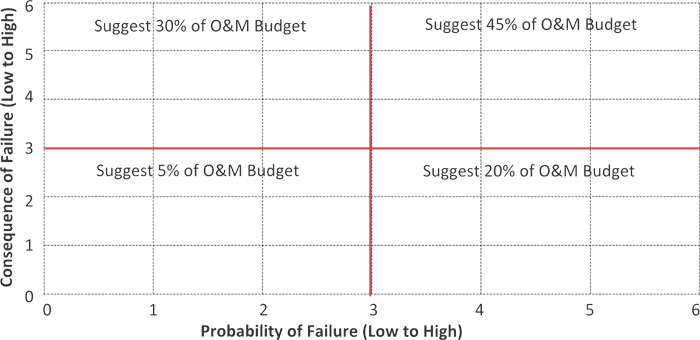
For most utilities, prior to initiating an Asset Management program, maintenance is usually spread out relatively evenly across assets. Following Asset Management principles changes this spread of maintenance tasks to one that is much more heavily oriented towards high risk assets. The criticality quad chart in Chapter 5 can be used to show how maintenance expenditures should be distributed across the four boxes. Most of the expenditures should be in the high risk box and very little should be in the low risk box. A quad chart showing a potential split of maintenance tasks by criticality is presented below.
Similar to maintenance expenditures, expenditures on condition assessment and monitoring should match risk. The greater the risk, the more worthwhile expenditures on condition assessment or monitoring. There is very little value in monitoring the condition of assets that have little risk of failure, particularly when the utility will probably take no action to prevent these failures.
Maintenance activities are an important part of preventing asset failures. However, it is never possible, even with the best maintenance program, to prevent all failures. At some point, the asset may have deteriorated or aged to the point that it is no longer feasible to forestall failure; or continued maintenance may be so expensive relative to the cost of a new asset that maintenance may no longer be the best option. In these cases, the asset should be replaced or rehabilitated through the capital improvement plan.
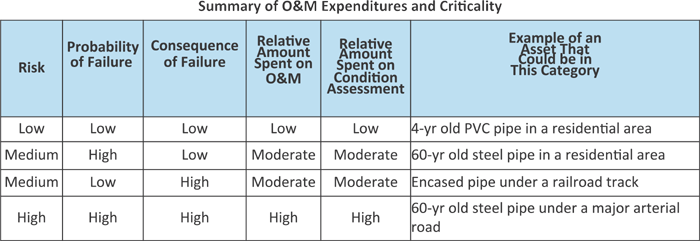
The table above summarizes the information regarding expenditures on O&M and related expenditures for condition assessment or monitoring.
6.4 Run To Failure
For low risk assets, the most economical option may be to allow the asset to fail. This allows the full life span of the asset to be achieved. This management strategy is called “run to failure.” You are choosing to let the asset run until it fails, at which time you will repair, rehabilitate, or replace it.
There are two categories of medium risk assets. The first category is high probability of failure but low consequence of failure and the second is low probability of failure but high consequence of failure. In the first case, these assets can be run to failure because the consequence is low. Since these assets are likely to fail, in the process of managed failure, the utility should be prepared for the repair or replacement of the asset. In the second case, the asset failure has high consequences. These assets are not generally ones that should be run to failure. Failures should be prevented if possible through maintenance activities or early replacement.
The final risk category – high risk – are those assets that are very likely to fail and they have serious consequences if they do. You would not want to use a managed, run to failure option for these assets; the risk of serious consequences is too great. In addition, replacing these assets sooner can prevent other serious consequences.
…when you properly priortize your assets…you can’t fix everything.
—Eric Saylor, Cincinnati, OH
6.5 Repair, Rehabilitate, or Replace: How to Decide?
When an asset failure occurs, the choices for how to respond include:
- Repair
- Rehabilitate
- Replace
In some cases, an asset can be repaired. The repair will not bring the asset back to its original condition, but it can keep the asset operational for a period of time. The condition of the asset at the time of the repair is an important consideration. If the asset retains a reasonable amount of structural integrity, a repair makes sense because the asset will still perform effectively. If, however, the asset shows significant deterioration, a repair makes less sense. One of the other options, rehabilitation or replacement, should be followed in this case.
We were spending about half our time on only 5% of our assets.
—Frank Roth, Albuquerque, NM
Sometimes, an asset can be rehabilitated to bring it close to its original condition and extend its useful life. Rehabilitation can be done before an asset fails, or in some cases, after failure. Rehabilitation is generally less expensive than installing a new asset, but more expensive than repairing the asset. Rehabilitation can be used effectively if the additional useful life is enough to justify the cost. An example of rehabilitating an asset is lining sewer pipe. If the pipe has some structural integrity left, lining the pipe can bring it to an almost new condition and give the pipe an additional 50 years or more. The lining also eliminates the need to dig up the pipe and replace it, which reduces the cost.
The last option is replacement. The asset can be replaced with a similar technology, a completely new technology, or a more efficient technology. The replacement should be one that makes sense for the utility from a capital and operational standpoint and should fit with the level of service goals and the long-term plans for operation.
The selection of repair, rehabilitation or replacement involves a consideration of: the feasibility of the options; the condition of the existing asset; the capital cost of each option; the operations and maintenance cost after the repair, rehabilitation, or replacement; the remaining useful life in each case; the decay pattern; asset criticality; energy use; and the impact on level of service.
- Feasibility of the Options: Not all of the options will be available in all cases. There may be cases in which the asset is too badly damaged to be repaired. There may be limited rehabilitation options for many of the assets or the asset may have been too badly damaged to enable this option
- Condition of Existing Asset: If the asset condition is fair or higher, repair may be a good option as long as the repair is relatively inexpensive compared to the cost of a new asset. In the case of a poor condition asset or an asset whose repair costs are high, replacement or rehabilitation may be better options.
- Capital Cost of Repair, Rehabilitation, or Replacement: The capital costs of each option should be determined.
- Operation and Maintenance Costs: Different options lead to different costs of operation and maintenance. The costs of maintaining an asset that has been repaired could be different than the costs related to an asset that has been rehabilitated or replaced. If the asset is one that uses energy, a cost difference may occur if a more energy efficient asset is installed to replace the asset or if the new asset has a different energy source.
- Remaining Useful Life: If the asset is repaired, the useful life will probably remain the same as before, although the initial failure could cause some decrease. If the asset is rehabilitated, the useful life can be extended to almost as long as the original asset. If the asset is replaced, the asset life will be the life span of the new asset. As an example, if an existing asset had a useful life of 40 years and was 30 years into its life at the time of the failure, repairing the asset will likely keep the 10 year remaining life; rehabilitating the asset may result in an additional 30 years of life (for a total of 60 years from installation to replacement); and replacing the asset might provide an additional 40 years of life for a total of 70 years of life for the two assets together. In this example, replacement only provides an additional 10 years, compared to rehabilitation. To make this option attractive, the cost of replacement would have to be close to the cost of rehabilitation. Otherwise, rehabilitation may be a better option than replacement.
- Decay Pattern: After an asset is installed, it will start to decay or deteriorate at some rate over the course of its useful life. In some cases the decay may be very slow at first and then start to increase until it increases very rapidly as it gets closer to the end of its life. In other cases, the decay may be more evenly distributed over the asset’s life. Each asset or asset class has a different type of decay pattern or curve. If the decay pattern was known for the various assets or asset classes, it would be easier to make decisions about what to do when the asset failed. If the asset was in the beginning of its decay curve, repairing a failure would make sense. If the asset was at the point where it was decaying at a very rapid rate, it would make more sense to replace rather than repair the asset. It is difficult to know the exact decay curve for each asset, but the utility’s experience with various asset classes can help determine how the asset will respond to failures. If the utility notices that a type of asset usually lasts 10 years before its first repair, then has a few repairs over the next 5 years, then seems to break constantly, a decay pattern can be established. This example asset has a slow decay rate for 10 years, then an increasing rate for 5 years, followed by a rapidly increasing decay rate, until the asset ultimately replaced. In this scenario, an asset should be repaired if it is in the first 15 years, and replaced within the next few repairs after that time. It will not be possible to know the decay pattern of all the asset classes, but it may be possible to know some of them, particularly assets that have shorter lives. Any historical knowledge you can gather to help define the decay patterns, will help you make a better determination of how to respond to an asset failure.
- Asset Criticality: When a high risk asset has failed, it may be more advantageous to replace or rehabilitate the asset, than to repair it. The risk of the asset failing again may be too great to allow for a repair.
- Energy Usage: If the asset is high priority from an energy standpoint (the asset is uses a lot of energy and it is highly feasible to do something about it) it should be replaced with a more energy efficient asset. Alternatively, if the level of service includes a goal to reduce green house gas emissions and the asset can be replaced by an asset that uses a “green” source of energy, replacement of the asset may be a good idea, even if this option is not the cheapest alternative. (There are resources, such as Portfolio Manager, that can help a utility determine energy usage and these resources are included in Chapter 10. Also, a table is included in Appendix D to assist utilities in the determination of potential energy savings projects.)
- Impact on Level of Service: Some options may have an impact, positive or negative, on the level of service. This impact must be taken into consideration in the evaluation of how to decide which option to choose.
All of these factors play a role in determining whether to repair, rehabilitate or replace the asset. The cost factors (capital and O&M) together with the information on useful lives provide good information regarding overall life cycle cost, while the condition, feasibility, level of service, and decay pattern provide insight into other reasons to pick one option over another. The overall risk of the asset may also drive the decision to replace or rehabilitate over repair. Some decisions may be obvious, while others may be much less so.
Thus far, the discussion has been focused on assets that have failed. Some high risk assets will need to be replaced or rehabilitated to prevent failure. Some medium risk assets, those with high consequences of failure, may also be replaced prior to failure. These replacement or rehabilitation projects can be done as planned activities and the costs can be included in the capital improvement planning process.
6.6 Capital Impr0vement Planning
A utility will have many reasons to install new assets or rehabilitate existing assets. The most common reasons are listed below.
- Replacement or Rehabilitation of High Risk Assets: As discussed in Section 6.5, some high risk assets will need to be replaced or rehabilitated on a planned schedule.
- Assets Related to Future/Upcoming Regulations: New rules at the state or federal level may require water or wastewater utilities to install new assets to meet the requirements. For example, when EPA lowers the Maximum Contaminant Levels (MCLs) of primary contaminants or begins regulating a new contaminant, the utility may need to add treatment technologies or make some other changes, such as developing a new water source, to meet the new regulation. It is important for utilities to be aware of upcoming regulations and consider how they may impact the capital needs of the utility.
- Assets Required for Growth: A utility’s service area may expand requiring new infrastructure to reach additional customers, or population growth may occur within the existing utility boundaries requiring expansion of capacity. This growth may result in the need for additional water resources, water and wastewater piping, treatment facilities or storage tanks.
- Assets Related to Utility Consolidation or Regionalization: Some utilities may find it advantageous to consolidate or regionalize with other nearby utilities. When this consolidation or regionalization includes a physical connection between the utilities, new assets may be required.
- Asset Replacement Related to Improved Technology or Energy Efficiency: In some cases, a utility may wish to replace an asset with a new asset that uses a different technology. The new technology may result in better operation or improved energy efficiency. Newer assets are often more energy efficient than older assets, so there may be opportunities for significant cost savings if an asset is replaced with a more energy efficient asset. In other cases, assets may be replaced by technologies that improve customer service or enhance operational efficiencies. Examples of this type of asset replacement include automatic metering of water utilities or a SCADA system that electronically controls the utility’s operations.
Projects needed to address any of the issues described above should be compiled into a Capital Improvements Plan. The plan, at a minimum, should cover 5 years, but a time horizon of at least 20 years is preferable. Although projects in years 15 through 20 are more speculative in nature than those in the first 5 to 10 years, this long range projection helps the utility plan for and fund its future capital needs.
The capital improvements plan should specify project priorities and the anticipated funding source for each one. The projects should be listed by the year in which they are planned. At a minimum, the capital improvement plan or CIP should include the following information:
- Description of the project
- Need for and benefits of the project
- Estimate of project cost
- Estimate of O&M including reductions in energy costs for projects that address energy efficiency
- Funding source(s)
It is important to note that the funding source can be internal or external. If the utility desires to track projects separately based on whether it will use internal or external funding sources, it can separate the projects between a CIP (projects funded by outside sources) and a Replacement Schedule (projects funded by internal sources) otherwise all the projects can be listed together on the CIP.
Appendix D contains a copy of a Capital Improvement Plan and Repair and Replacement Schedule.
The CIP needs to be updated annually so that it always covers the same length of time. As projects are completed, they should be removed from the list. Projects listed for the current year that were not completed should be moved to a later year. If no projects are anticipated for a given year, the CIP should reflect this. Appendix D contains an example table that can be used to develop the CIP. There is also an example table for a Repair and Replacement Schedule.
Capital Project Validation
Deciding to replace an asset does not fully address the question of how it should be done. Because capital projects can be such a significant expense for a utility, it is critical that the projects be validated to make sure the project is necessary, all potential alternatives are considered and the best alternative is selected. To address these concerns, a business case evaluation should be performed that includes the following type of information:
- Project Description
- Need for Project
- Benefits as a Result of the Project
- Risk of Not Doing Project
- Current Asset Condition
- Estimated Useful Life of the Existing Asset
- Estimated Useful Life of the New Asset
- Probability and Consequence of Failure
- Current O&M
- Capital Cost of Proposed Project
- O&M of Proposed Project
- Options for O&M to forestall the capital project
- Alternatives to Proposed Project, including Non-Asset Alternatives
We’re able to document a long-term savings of over $10 million.
—Kevin Campanella, Columbus, OH
Many of the items are self-explanatory. The remaining items are explained below. One of the items on the business case evaluation is the options for using O&M to forestall a capital project. In some cases, there may be opportunities for O&M interventions that can keep the asset in service for some additional time period to delay the capital project. These options, as well as the cost of the option and the number of years gained in useful life, need to be documented.
No matter what the proposed project, there are almost always alternatives. There may be alternatives with different combinations of capital and O&M costs that can be compared to determine whether a project with higher capital cost and lower O&M cost is more advantageous than a project with lower capital and higher O&M cost. There may be alternatives more closely match community values or alternatives that are more comfortable for the current operators. It is absolutely critical that a thorough analysis of all the alternatives be completed and that the analysis is done objectively. All reasonable alternatives should be clearly presented, along with cost information.
A specific type of alternative that should be included, when feasible, is a non-asset solution. Non-asset solutions are alternatives that address a need without actually installing assets. For example, consider a utility that maintains a fleet of vehicles and has a vehicle maintenance yard that is in disrepair and needs rehabilitation or replacement. Perhaps it will cost $500,000 to do the maintenance yard repairs, but it turns out that the utility needs its vehicles infrequently. Instead of rehabilitating the maintenance facility, it may be possible to enter into a sharing arrangement with a neighboring utility and pay for the use of vehicles on an as-needed basis. This type of solution may cost more on a per-mile basis than owning the vehicles outright, but since they are not needed constantly and the maintenance yard would no longer be needed, the overall cost of operation might be much lower.
When done correctly, a business case evaluation can take time to complete. Therefore, it may be a good idea to use this process only for projects above a certain dollar amount. Different utilities will set different limits depending on the size of the facility. A smaller utility will probably set a lower dollar amount than a larger utility. Each utility should select a dollar amount that allows most major expenditures to go through the process, while not overly burdening the personnel.
A business case evaluation can have several possible outcomes. These outcomes include:
- Project should go forward in current year’s CIP
- Project should be delayed until a future year’s CIP
- Insufficient information was presented in the business case; project should be re-submitted with additional information
- Alternatives should be investigated and the project should be re-submitted with the additional information
- A different alternative than the one selected should be chosen
- Additional O&M is recommended; the project should be delayed for some number of years
- Project should not go forward
Projects should proceed only if the most appropriate alternative has been selected and both the need and benefit are clearly shown. If these conditions are not met, one of the other options as outlined above should be selected. If more information is needed, the project can be re-evaluated and re-submitted.
Because capital expenditures account for such a large portion of the overall budget of most utilities, a good capital project validation process can provide significant cost savings for even small utilities. As an example, Arenas Valley, a small utility included in this manual, was contemplating a capital project that included replacement of much of their water distribution system. This project would have cost approximately $5 million dollars. A validation process showed that the project was not needed. Instead, the utility would benefit from looped lines, isolation valves, and a limited pipe replacement project. This project was completed at a fraction of the cost of the original project and increased the level of service for the customers.
A business case evaluation form is included in Appendix D.
6.7 The Data and Decision-Making Cycle
Making good decisions relies on knowledge. Knowledge comes from data but is not equal to it. A utility can have a lot of data and very little knowledge if the data is incomplete, of poor quality, inaccessible, or of the wrong type. For example, a utility may have 2,000 repair records for their main line pipes for the past 10 years. The records are scattered around an office and many of them are incomplete. There is no consistency between the records, so it isn’t easy to tell what work was done. Information such as pipe type and size is missing from the records. Clearly, the utility has a lot of data. What it doesn’t have is knowledge. This utility would not be able to determine which type of pipe was breaking nor could it comfortably rely on the data due to the poor quality. It would also be hard to use the data because it is in paper form and scattered throughout the office.
When they reach a point where it’s breaking at twice our average break rate…is when we would start to proactively replace that pipe.
—Kevin Campanella, Columbus, OH
Instead, utilities need to determine what data they need to collect to gain the knowledge to make good, sound decisions about the management of the assets. Once this determination is made, the need to ensure good quality and thorough record keeping must be passed on to all of the staff.
At the beginning of an Asset Management program, it is highly unlikely that a utility collects all of the data it needs at a sufficient quality, organized in an accessible manner. Most likely, the utility will need to figure out what data it wants in order to improve decision-making. It will also have to establish parameters for the data quality and determine the best method to store the data.
The utility should consider data gathering and decision-making to be a cyclical process. Data will be collected and analyzed to gain knowledge and inform the decision-making process. This analysis will also point out weaknesses in the data, data quality, or data storage system. These weaknesses can be addressed and the process can be repeated. For the first several years of the cycle, considerable gains will be made in the ability to make decisions about the right way to manage the assets each time through the cycle. After that, the utility will still make gains, but the increments will be smaller.
Just as there may be data that is needed and is not collected, there may be data that is collected but not needed. If data is not useful for operations, maintenance, or capital decision-making and there is no other compelling reason to obtain the data, it should no longer be collected. Data should not be collected for data’s sake; the collection of data takes time and resources and should only be done if there is a need for it.
…for our highly critical assets, we’ll do frequent condition monitoring…
—Scott Maring, Cincinnati, OH
An example of the data and decision-making cycle is the following. A wastewater utility wishes to determine if something can be done to address sewer back ups. The initial data available is the number, but not location, of customer complaints. The utility doesn’t have enough information to proceed, so it can decide to start collecting more An example of the data and decision-making cycle is the following. A wastewater utility wishes to determine if something can be done to address sewer back ups. The initial data available is the number, but not location, of customer complaints. The utility doesn’t have enough information to proceed, so it can decide to start collecting more information on each sewer back up. It develops a process to collect data on each back-up on a written form that is filled out in the field. The field data is then input into a simple computer spreadsheet. The data includes date, time, location, pipe type and size, and nature of the problem. Using this data, the utility begins a sewer cleaning program. The utility examines data for sewer back-ups for a year after the cleaning program is initiated to determine the effect. The utility notices that in one part of the utility, there was a significant improvement in the number of back-ups, but in another part of the utility, there was no improvement. Now the utility needs additional data on the sewer lines that are still experiencing back-ups. The utility decides to televise these sewer lines. The televised data show that several lines have severe root intrusion in the sewer. The utility begins a program to remove the roots. Data on sewer back-ups is analyzed for a year following the root removal to determine the impact. The utility determines that the cleaning program and root removal efforts have made a significant decrease in the number of sewer back-ups.
A data decision-making cycle that includes data collection, data analysis, decision-making, and action followed by data collection, data analysis, revised decision, and action can be used to address many operational and managerial concerns within a utility.
The business case showed that this was the way to go.
—Eric Saylor, Cincinnati, OH
6.8 Balancing O&M and CIP Costs
Utilities should strive to achieve a balance between operation and maintenance costs and capital expenditures. Spending more in one area can impact the expenditures in the other. For example, spending more on maintenance can extend the life of an asset and forestall a capital expenditure for a period of time. Alternatively, if assets are replaced frequently, these capital expenditures reduce the need for maintenance. Consider the example of a car. A car can be kept in service for 15 years or more if regular and preventative maintenance is performed. In this case, the expenditures on maintenance would be high but the expenditures on capital would be very low. The opposite mode of managing the car would be to purchase a new car every 2 years. In this case, there is very little need to do any maintenance at all, even oil changes. Besides adding gas, the car would likely run for two years without maintenance. In this case, the expenses for maintenance would be minimal, but the expenses for capital would be extremely high. Consider the expenses associated with each type of operation as shown below:
Example 1: Maintaining Car for a 15 Year Life
- Initial Cost of Car: $18,000
- Maintenance Cost
-
- * Average $100/month years 1 to 5 * Average $200/month years 6 to 10 * Average $300/month years 11 to 15
Total cost/year on average for 15 years = $3,600/year
Example 2: Buying a new car every 2 years.
- Initial Cost of Car: $18,000
- New Car every two years at $18,000/each
- Maintenance Cost: Average $5/month
Total cost/year on average for 15 years = $9,060/year
Although these two modes of managing the car represent extremes, they are illustrative of the point that, generally, spending more on operation and maintenance and less on capital is the least cost method of managing assets. However, the risk of failure is somewhat higher with this type of management.
This risk is one reason to shift the balance in one direction or the other. When an asset is extremely high risk (high criticality,) the risk associated with the failure may be so great that the asset needs to be replaced sooner and the potential to keep it in service with maintenance may be reduced.
Another factor affecting the balancing between capital and O&M is the ability of the utility staff to manage the maintenance required to keep the asset in service.
Where do we spend those revenue dollars? Do we spend more on capital projects…or do we spend more on operations?
—Stan Allred, Albuquerque, NM
6.9 Managing Risk
The main consideration with all operation and maintenance activities and capital expenditures is how much risk the utility is willing to tolerate. The utility can spend less if it is willing to accept more risk (i.e., increased failures of high and medium risk assets) and more if it is willing to accept less risk (i.e., intervening to prevent failures for high and some medium risk assets.) The utility should invest money to reduce the failures it feels cannot be tolerated. This investment should be made in both operation and maintenance expenses and capital expenditures. Money should not be spent to prevent failures of low risk assets. These assets should be replaced after they fail.
As a starting point, a utility can ask itself the following questions:
- Did we experience bad consequences from failures last year?
- How bad were they for customers?
- Did customers complain about the consequences of any of the failures?
- Did we incur additional costs from fines or legal expenses because of severe consequences?
If the utility can say that there were few really severe consequences from failures, then perhaps the utility is appropriately managing its risk from asset failures. If the utility had a lot of negative consequences from failures and the customers are expressing concerns about failures, then perhaps the risk level is not well-managed. In that case, the next questions the utility should ask include:
- Are we doing enough to prevent highrisk assets from failing?
- Are the maintenance activities focused on the high risk assets?
- Have we properly identified the high risk assets?
- Will our customers be willing to pay more to reduce the risk in the facility?
All of the techniques and tools in this chapter should help the utility manage its risk at the appropriate level.
When I cannot bear the risk of that asset failing, I will replace it.
—Ross Waugh, New Zealand