
1.1 What is Asset Management?
In the simplest terms, Asset Management can be thought of as applied common sense. Asset Management is designed to help people decide how and where to spend their money to achieve the desired results. Such a process is needed when there are competing priorities for limited funding.
As an analogy, think of your car. If you are driving your car and it gets a flat tire, what will you do? Will you fix the car or buy a new car? Because tires are inexpensive compared to the overall cost of a car, the most likely response is to repair the tire or put a new tire on the car. Think about what factors would go into a decision like this: the cost of the tire, value of the car, reliability of the car, and whether the flat tire caused any other damage to the car. However, in general, deciding what to do in this case is pretty simple.
What if instead of a flat tire, your car has a cracked engine block. Now what will you do? Will you fix the engine, put a new engine in the car, or buy a new or used car? Is it more difficult to decide what to do in this case? Why? Probably factors like cost of repair, cost of new engine, value of existing car, cost of a new or used car, reliability of existing car, value of existing car, current operation and maintenance cost, and many others would enter into the decision. This decision would involve collecting data and examining all the options over time.
If all of your decisions were like the tire example, you wouldn’t need a formal program to help you make them. Unfortunately, you will have many decisions that are more like the cracked engine block. Funds are limited and there are many competing priorities for those limited dollars. Therefore, a program that will help you collect the data you need and provide a framework for making these decisions is very beneficial. Asset Management is designed to be this type of program.
Will you have enough money by the time it fails to fix it?
-Mike Daley, Gallup, NM
Asset Management is maintaining a desired level of service (what you want your assets to provide) at the lowest life cycle cost (best appropriate cost – not no cost.) Asset Management provides a set of tools and practices that can assist a utility in operating, maintaining, and managing assets in a cost-effective, sustainable fashion. The reasons a utility may wish to operate in this fashion include:
- Water and wastewater assets represent a major public or private investment. In small communities, these assets may be the largest investment.
- Well-run and efficient infrastructure is important to economic development.
- Proper operation and maintenance of a utility is essential for public health and safety.
- Utility assets provide an essential customer service.
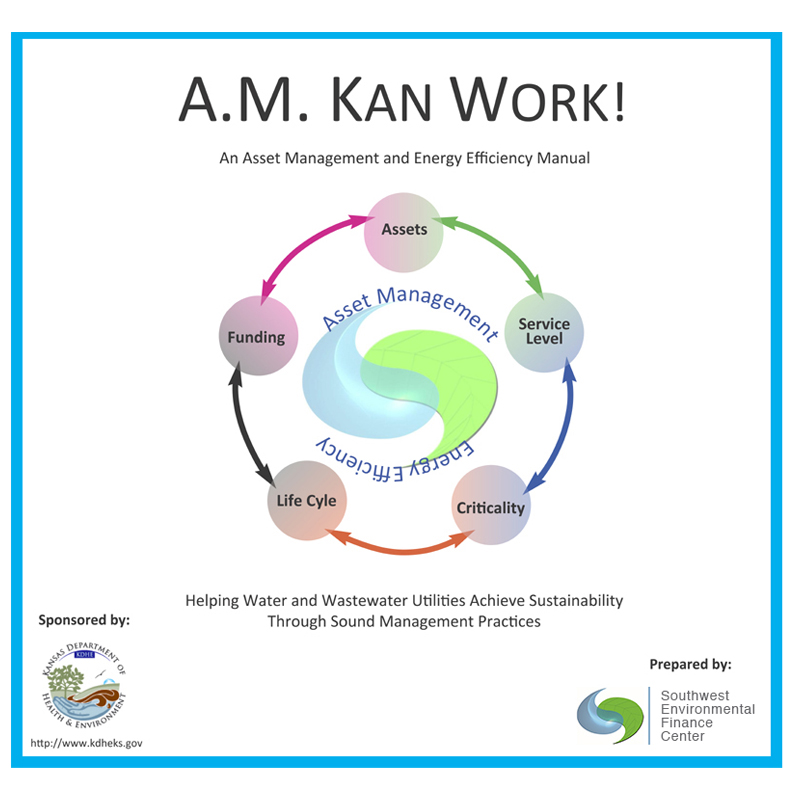
There are five core components of Asset Management:
- What is the Current State of the Assets
- What is the Desired Level of Service
- Which Assets are Critical to Sustained Performance
- What is the Best Life Cycle Cost
- What is the Long-Term Funding Strategy
Each of these core components is described in detail in Chapters 3 through 7. Information regarding implementing Asset Management, the human aspects of Asset Management, and resources to assist utilities is also included in the guidebook.
Additionally, this guidebook includes considerations of energy efficiency throughout each of the components. The process of Energy Efficiency Management follows a similar framework to Asset Management, so following this guidebook will provide the utility with the tools to develop a comprehensive program of managing its assets in a cost-effective, environmentally- sound and energy- efficient manner.
It’s mostly using common sense.
-Larry Covington, Picacho, NM
The Asset Management program described in this guidebook is compatible with the Environmental Protection Agency’s Advanced Asset Management Training and current international practice in Asset Management. Further information on EPA’s training can be found at the following web site: http://water.epa.gov/type/watersheds/wastewater/index.cfm
The international approach can be found in the International Infrastructure Management Manual prepared by the NAMS Group in New Zealand.
1.2 Benefits Of Asset Management?
The intent of Asset Management is to ensure the long-term sustainability of the water or wastewater utility. By helping a utility manager understand what assets the utility owns in order to make better decisions on when it is most appropriate to repair, replace, or rehabilitate particular assets and by developing a long-term funding strategy, Asset Management can assist the utility in ensuring its ability to deliver the required level of service far into the future.
There are many positive benefits of Asset Management. Utilities that fully embrace Asset Management principles may achieve many or all of these benefits. Some benefits may be achieved just by initiating Asset Management activities.
Some of the potential benefits of Asset Management are listed below and discussed in the following short videos. However, the type and extent of benefits that can be realized through implementing an Asset Management program are unique to each utility and community. The benefits that you achieve in your utility will depend on which aspects of the program are most important to you, where you focus your efforts, and the needs of your community.
1.3 Energy Efficiency
A utility has the responsibility to its customers to deliver service at the lowest possible cost and with the least impact to the environment. Water and wastewater utilities require large amounts of energy to operate, and energy represents the largest controllable cost in a utility’s budget. An enhanced, comprehensive Asset Management program that incorporates energy efficiency and greenhouse gas or carbon footprint reduction goals will be a much more effective tool than either an Asset Management Program or Energy Efficiency Management by themselves. Including energy efficiency objectives within an Asset Management program makes sounds business sense, is environmentally responsible, and contributes to the sustainability of the community.
…starting an Asset Management Program, I would definitely try to correlate energy management into that program
-Russell Batzel, St. Peters, MO
A complete inventory of each asset and its respective functionality, including its energy use and environmental impacts, will allow the utility to make operational decisions based not just on asset life-cycle but also on that asset’s impact on the utility’s overall energy efficiency plan. An asset that is not performing optimally will almost always have a negative impact on energy efficiency. While energy efficiency programs generally focus on utility components that are connected to a power source, a comprehensive Asset Management program considers the total cost and energy impact of asset use. This will include assets that, through under-performance, may waste energy in ways that are not directly measured at the power meter. For example, a leaking pipe that wastes water is also wasting the energy used to pump and treat that water prior to entering the pipe. And whatever wastes energy will likely waste money, and increasingly so as energy costs inevitably rise.
When we have the opportunity to incorporate energy efficiency, we wanted to do that.
-Steve Hunt, Columbia, MO
With the growing emphasis on energy conservation and environmental impact, it is crucial for utilities to incorporate these important factors into operational strategies. Incorporating energy evaluations and energy efficiency measures into the Asset Management plan from the outset is an efficient and effective way to take responsible action for energy efficiency as well as operational and financial efficiency.
1.4 Intended Audience
This guide to Asset Management can be used by any water and wastewater utility, but it is geared primarily toward small to medium-sized utilities. For utilities that wish to have a more robust Asset Management program, there are other guides, resources and consulting services that can help implement a more sophisticated program. This guidebook contains all the basic elements of Asset Management, and discusses implementation as well as the human aspects of Asset Management. Utility employees at all levels should be able to use this guidebook, including operations or management personnel, elected officials or board member