
2.1 The Way To Do Business
Asset Management must become the way a utility does business. It cannot be something the utility does on the side as one of its many activities. Asset management thinking must underlie every activity, every action, and every decision that the utility undertakes. The Asset Management Plan must not be a theoretical document that overlays “business as usual” or a top-down decree that the utility staff views as an unnecessary burden. Nor can it be a methodology used by middle managers that is unknown to or unsupported by the governing body. It must be the paradigm from which all personnel, from elected officials or board members to managers, administrative staff, and operators, think about how they do their job.
2.2 Achieving “Buy-In”
Having Asset Management underlie all of the utility’s activities means that there must be “buy in” for the Asset Management concepts at all levels of the utility from the field staff to elected officials or owners. Every employee should understand that Asset Management is important to the overall function of the utility. If there is insufficient acceptance of Asset Management, the plan will be much less successful or may not succeed at all.
One way to obtain acceptance of Asset Management is to explain the overall goal of the utility’s Asset Management strategy to each employee or volunteer and how that particular employee will participate in the process. When Asset Management is adopted as the way of doing business, each employee’s input, knowledge and expertise is important to the process and all are crucial to the successful implementation.
Each activity that is undertaken must have Asset Management thinking at its core. For example, when working on the water utility to fix a break, the operator should have a map of the utility and indicate on it the exact location of the break. The operator should note all information pertinent to the Asset Management program, such as: location of break, type of break, type of pipe, type of repair, length of time from report of leak to response to scene, length of time to repair the pipe, materials used, and difficulties encountered. This information can then be used in many ways. Did the same pipe rbreak multiple times? Has the utility experienced more breaks on one type of pipe than another? Did the operator respond in a timely manner? Did the repair get fixed in a timely manner? By tracking this type of data a utility manager can begin to develop a more comprehensive picture of the overall utility and its operation.
Another example is a customer complaint. When the utility receives a customer complaint, it should track various items such as: What routine maintenance or operational activities were taking place in the time frame before the complaint? Is there any unusual condition that would cause this type of problem? Has this complaint been made before? Is there a pattern of complaints of this type (same area, same source, etc.)? Has an operator been dispatched to check out this type of complaint? How long did it take to respond?
Throughout the entire utility – whether it has 3 employees or 300 – every employee or volunteer should be considering how their activities impact the overall operation of the utility and how their activities fit within the broader structure of the Asset Management and energy use plan.
One of the best approaches to receiving buy-in or acceptability of the Asset Management program at the water or wastewater utility is to demonstrate successes using the Asset Management techniques. There are many small successes that the program may demonstrate that can be used to convince even reluctant employees or volunteers that the efforts will benefit the utility. As an example, producing a map showing the utility’s assets in a visual format can be of great benefit to the utility, especially if there has never before been a comprehensive map showing these assets.
2.3 Obstacles
Because implementing Asset Management requires changing the way the entire utility does business, it requires that employees change the way they think about their jobs and their relationship to the rest of the organization. This can be difficult for many people. Some employees may be reluctant to change methods that have worked in the past. Others may be anxious about the security of their jobs.
Some may not understand the concepts, or view it as just another management fad or gimmick. Still others may be afraid they will be assigned extra duties to overload their already-full work schedule, or feel overwhelmed by its scope. Elected officials may be wary of extra cost.
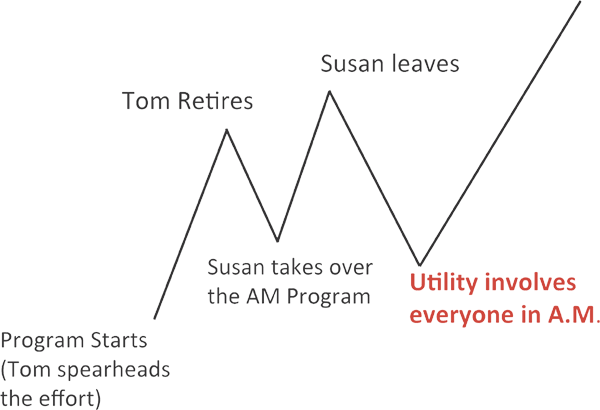
Because any new way of doing business is bound to encounter obstacles, it is important that those in charge of the implementation process develop ways to overcome those obstacles and ensure the buy-in of all concerned. If this is not successful, the utility may experience what is known as the “saw-tooth effect” (Ross Waugh, 2010) in which the utility makes great strides in the beginning because of the enthusiasm and dedication of one or a few individuals . But when those individuals leave the utility through retirement or for other reasons, or if they grow tired of carrying the full load of implementation, the utility may experience a severe drop in the progress made in Asset Management. There may be a subsequent increase in interest when others take up the effort, but this up and down movement is inefficient and wastes valuable resources that could be put to good use to further progress towards the goals of efficiency and sustainability.
It is therefore extremely important to ensure every member of the organization is familiar with and accepts the goals of the program. This can be done with presentations, videos, trainings, posters, or any other informational method that reaches the employees. The best way to overcome these obstacles and secure buy-in is to involve every member of the organization in the implementation. When people are involved and have a voice in decision-making, they feel a sense of ownership. When their ideas are heard and considered, they will support the final product, even if their specific ideas are not included in the final plan. In addition, the synthesis of many ideas will create a more robust program than top-down decrees from management personnel who may not be fully aware of the issues faced by field personnel.
2.4 Work Smarter Not Harder
Asset Management may first appear to be the type of program that will require personnel to take on more work and be overtaxed and it may seem as though there is no way to ever fit these extra duties into an already tight schedule. Asset Management is not meant to be a burdensome activity. It is actually quite the opposite. It should provide tools that change what you do and how you do it so that you become more efficient and effective, have more planned activities and less reactionary activities, and make better decisions. Asset Management is designed to allow you to work smarter not harder.
There may be times in the short term that Asset Management activities require a little additional time or effort to allow you to transition from the “old way” of doing things to an Asset Management way of doing things, but the time spent will be worth it in the long run.
The single biggest factor that will make you successful in your Asset Management endeavors is to open your mind to a new way of thinking about your assets and how you manage them. Changing your thinking, alone, will have a big impact on how you operate and manage your utility.