
5.1 Introduction
Not all assets are equally important to the utility’s operation. Some assets are highly critical to operations and others are not critical. Furthermore, the criticality of assets is completely utility specific. Certain assets or types of assets may be critical in one location but not critical in another. For example, a utility may have only one well that serves the entire community so that well may be a critical asset. Another utility’s well may not be a critical asset because it has multiple wells and a large storage tank with capacity to store enough water for several days. A utility must examine its own assets very carefully to determine which assets are critical and why.
Does it feed a critical customer?
—Jim Smith, Louisville, KY
In determining criticality, two questions are important:
- How likely is the asset to fail?
- What is the consequence if it does?
Criticality has several important functions, such as allowing a utility to manage its risk and aiding in determining the balance between expenditures for operations and maintenance, and capital projects.
5.2 Probability of Failure
The first step in determining criticality is determining how likely an asset is to fail (or the probability of failure for a given asset.) There are four modes by which an asset can fail.
- Mortality – the asset physically fails either through collapse, rupture, or some other mechanism
- Financial Inefficiency – the asset is costing so much to operate and maintain that it is no longer economical to keep it in operation
- Capacity – the asset is still operational, but is unable to provide the capacity needed
- Level of Service – the asset is still operational, but is unable to meet the level of service required
Mortality (when an asset is unable to perform its function) is the mode most commonly considered when thinking about failure. When Asset Management approaches are adopted, the other three modes also become important. When costs of operation and maintenance activities, as well as repairs, are cosidered on an individual asset basis, it is possible to determine the point at which it no longer makes economic sense to keep the asset in service. This is the point at which it is actually cheaper to replace the asset than to continue to operate and maintain it. The final two failure mechanisms occur in assets that may be functioning properly. However, they are no longer providing either the capacity needed or the service level desired.
In thinking about how each individual asset might fail, all four mechanisms need to be considered. However, the first two modes are the most likely for the majority of assets. At the beginning of an Asset Management program it is unlikely that historical data on operation and maintenance will be available on an individual asset basis and it may take time to get a program in place to track this data. For this reason, the focus of this discussion will be on the physical mortality failure mode.
To determine the likehood of failure of an asset based on physical mortality, factors such as age, condition, repair history, operation and maintenance history, historical knowledge, experience with similar assets, and knowledge of factors affecting physical mortality, should be considered. An asset that is nearing the end of its useful life, is in poor condition, has a long history of repairs, and a poor history of maintenance is highly likely to fail. On the other hand, an asset that is relatively new, has no repair history, is in good condition, has had routine and preventative maintenance, is unlikely to fail. The factors that affect the probability of failure for an asset are described in more detail below. No single factor should be the sole predictor of likelihood of failure. Rather, all the factors about the asset should be taken collectively in determining probability of failure.
Asset Age: Over time, assets deteriorate, either from use or from physical conditions such as interaction with water or soil. There is no “magic age” at which an asset can be expected to fail. An asset’s useful life is highly related to the conditions of use, the amount of maintenance, the original construction techniques, and the type of material used in construction. A piece of ductile iron or cast iron pipe may last 75 to 100 years in one application, 150 years in another, and 50 years in yet another. If age is the only issue with an asset, the probability of failure can still be relatively low even if the asset is quite old. For example, if the utility has cast iron pipe in the ground that was installed properly, made with good manufacturing techniques, and has never had a history of failure, it does not necessarily have a high probability of failure, even though it is 75 years old.
In order to use age as one measure of probability of failure some knowledge of potential useful life is necessary. This concept was discussed in Chapter 3. Each asset or type of asset should be assigned a useful life or life expectancy so that the actual age can be compared to the useful life. In this manner, it is possible to determine how much of the asset’s life is “used up.” The closer the asset gets to the end of its life, the more likely the asset is to fail. For example, a 35-year-old concrete interceptor that is expected to last 70 years has only reached the mid-point of its life expectancy and would not be likely to fail. If its useful life was only 40 years, 88% of its life is used up, so it is more likely to fail. As discussed in Chapter 3, the useful life values can be adjusted up or down if actual experience shows that the assets average more or less life expectancy than your initial estimate.
Asset Condition: Another important factor in determining an asset’s probability of failure is the condition of the asset. As the asset’s condition deteriorates, it will be more likely to fail. It is important, therefore, to make the best possible attempt to give the assets a reasonable condition assessment. Obviously, assets given a poor or fair condition rating are more likely to fail than those given an excellent or good rating.
The condition assessment should be updated periodically, so that the criticality can also be updated.
Repair History: It is important to monitor repairs resulting from some type of failure and record the type of event that occurred. This information should be as specific as possible to assist the utility in understanding its failure modes. Systems should track when the asset failed (or at least when the failure was discovered), how the failure was determined (customer report, operator observation, lack of service in that part of the utility, etc.), type of failure (e.g., rupture, mechanical failure, small leak), specific location of failure, and any field observations that may help explain the failure (e.g., lack of bedding sand, subsidence of soil, overheating, etc.) Failure history should be tracked on all asset categories.
Past failure is not completely predictive of future failure, but it can provide some indication of the probability of future failure, especially if detailed information on the past failures is collected and reviewed. If the asset failed because its construction or condition was poor, it is likely to fail again unless some action was taken to correct the problem. If the asset failed because of some action or incident unrelated to its condition or operation (e.g., a construction crew ruptured a pipe or a car hit a fire hydrant), it is not likely to fail again after the condition is corrected. If a pipe has failed several times in the past few years, it will be more likely to fail. If the pipe has never failed, it will be less likely to fail in the future.
Operation and Maintenance History: Knowledge of how the asset was operated and maintained will provide information about how likely the asset is to fail. The lack of adequate maintenance is likely to shorten an asset’s useful life and cause premature failure.
Historical Knowledge: If the utility has any additional knowledge regarding the asset, it should be considered in the analysis of probability of failure. This type of information may include knowledge of construction or manufacturing practices used at the time the asset was installed or knowledge of materials used in the utility.
Experience with Similar Assets: Although probability of failure is asset and site specific, some guidance regarding probability of failure can be gained by examining experience with similar assets at your facility or other facilities. For example, if there is a history of a certain type of pump failing frequently after 2 years of use, and a utility has that type of pump and it is currently 18 months old, the asset should be given a higher probability of failure than it would if there was no general experience of this type.
Knowledge of Factors Affecting Physical Mortality: There are two types of assets in water and wastewater utilities – vertical or active assets and horizontal or passive assets. Vertical assets are typically visible plant assets, and include assets such as pumps, blowers, mixers, diffusers, and chlorinators. Horizontal assets are field assets, generally buried, and include pipe, valves, manholes, meters, and service lines. It’s important to know the difference between the two types because different factors affect their physical mortality.
In vertical assets, the asset usually has moving parts so the asset fails with use rather than age. Failure is related to overall run time, frequency of starting and stopping, quantity and type of routine and preventative maintenance, conditions of exposure (corrosive environment, extreme heat or cold, severe weather,) improper alignment, and lubrication.
In horizontal assets, the assets are passively providing service. These types of assets fail with age because they are in constant service. Failure is related to soil characteristics, saturation level of soil, physical loads, bedding conditions, asset material and related attributes, construction conditions, exposure to weather, and quantity of internal and external corrosion.
It is important to consider all of the relevant factors when assessing an asset or class of assets’ probability of failure. The factors taken together provide an overall assessment of the asset’s likelihood of failure due to mortality. If, however, a given asset is more likely to fail based on one of the other modes of failure (financial inefficiency, capacity, or level of service) before it fails due to mortality, the probability of failure should match that mode of failure instead. The assets should be assigned a probability of failure rating based on how likely the asset is to fail on a scale of 1 to 5 or 1 to 10 or some other scale of the utility’s choosing. An example rating using 1 to 5 is shown below.
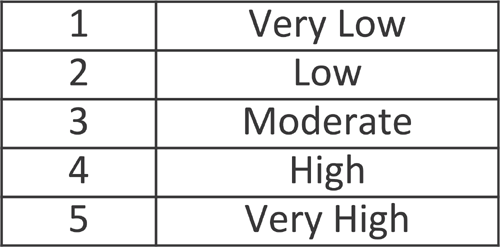
The ratings can be developed by a team of people who are knowledgeable about the assets, gathered together in a room to decide how the assets should be ranked. This ranking does not have to be a long, time-consuming activity. A small utility should be able to complete this process by meeting a few times for a few hours. A larger utility may take a little longer.
An important consideration is the fact that the assets should be ranked relative to each other. The rankings should not be compared to other utilities; this system is meant as an internal tool only. The goal is to determine which of your assets are more likely to fail than other assets in your utility.
Once the assets are ranked according to the chosen scale, the results can be reviewed to see if they make sense. If you believe the assets that are ranked highest in terms of probability of failure are the ones most likely to fail, then the results are fine for a starting point. If not, then adjustments can be made until the rankings make sense.
A more sophisticated approach can be used, but a simple ranking like 1 to 5 works very well and will not take a lot of time to accomplish.
5.3 Consequence of Failure
After you determine the likelihood of failure of each asset, it is important to determine how bad a failure would be. This determination of consequence of failure involves the consideration of several tangible and intangible factors:
- Cost of repair/replacement
- Social impacts or costs
- Environmental impacts or costs
- Costs or impacts related to collateral damage caused by the failure
- Legal costs associated with asset failure
- Public health impacts or costs
- Reduction in Level of Service
- Any other costs or impacts related to the asset failure
The consequence of failure can be high if any of these costs or impacts are significant or if there are several of these factors that might occur with a failure. Further discussion of each of these factors is presented below.
Financial Cost of Repair: When an asset fails, it will be necessary to repair or replace the asset. Depending on the type of asset and the extent of the failure, repair may be simple or extensive. A small leak in a pipe can be repaired with a clamp. A chlorine pump can be replaced with a spare pump or perhaps the parts can be replaced inside the pump. The failure of a well may be much more involved and may require much more extensive repair efforts. Some failures may be so severe, or repairs may be so expensive that asset replacement is required. The financial cost of the repair or replacement of the failed asset must be considered in the analysis of the consequence of failure. If the asset can be repaired easily and without a tremendous cost, then there is a lower consequence. If the cost of repair is higher, then the consequence of the failure is also greater.
Social Impacts or Costs: When an asset fails, there may be an inconvenience to the customer. In some cases, this inconvenience may be minor, while in others it may be much higher. If a pipe must be repaired in a residential area, there may be a few customers who are out of water for a short period of time. This outage would constitute an inconvenience, but would not be a severe situation. On the other hand, if the utility has very few isolation valves so that any repair requires the whole utility to be shut down, the inconvenience to the customers is much greater. In the first case (simple repair in residential area that shuts off a few customers), the consequence of failure related to the social impact is low. In the second case where the whole utility must be shut down to make any repair, the social impact is much higher. When framed in terms of inconvenience, social costs appear insignificant, but to your customers, the inconvenience may be extremely important and may impact how they feel about the utility in general. If customers have a negative impression of the utility, it can impact the ability to raise revenue.
Social impacts may be hard to quantify in dollar terms, but they need to be included in the analysis of consequence of failure in some way, either quantitative or qualitative.
Costs or Impacts Related to Collateral Damage Caused by the Failure: In some cases, when an asset fails, damage may be caused to other assets within the utility or to assets unrelated to the water or wastewater utility. An example of this type of damage might include a water line failure causing a sinkhole which causes major sections of a road to collapse or damages the foundation of a building. In addition, cars may be damaged in the sinkhole. The damage from the pipe failure without the sinkhole would be fairly minimal. With the sinkhole, there is collateral damage including the road, the building, or cars. Another example would be a sewer pipe failure that leaks sewage into a home or yard or onto a schoolyard or playground. In this case, a significant amount of cleaning will be required to restore the property. The utility will be held responsible for this collateral damage, so the costs related to this type of failure need to be considered in the assessment of costs of failure. Collateral damage may also occur within a utility. If a sewer collapses, debris may be delivered to the wastewater treatment plant which may damage motors or other moving parts.
Legal Costs Associated with Failure: In some cases, individuals or businesses may sue the utility for damages or injuries caused by an asset failure. These costs would be in addition to the costs of repairing and replacing damaged property or other assets. For example, imagine a driver is driving down the road and his car falls into a sinkhole caused by a water line failure, and the driver sustains an injury. The driver may sue the utility to cover the costs associated with the injury and loss of work time. Utilities may also be sued for causing significant environmental damage.
Environmental Impacts or Costs: Some types of asset failure can cause environmental impacts. The costs related to these impacts may not always be easy to assess in monetary terms. However, some attempt should be made to assign some type of quantitative or qualitative value to the environmental consequences. An example of an environmental cost related to a failure would be a sewer pipe that leaked sewage into a waterway or onto public or private land. A value, either monetary or qualitative, would need to be placed on this type of consequence. If the leakage could result in a regulatory fine, the cost of the fine could be included. The cost of other environmental damage can be assessed qualitatively or a dollar amount can be estimated. A failure that could result in raw sewage being discharged into a major waterway should be given a high consequence rating; a failure that would have the potential to cause a more limited environmental impact could be given a medium rating; and a failure that would cause no environmental impact could be given a low rating.
Public Health Impacts or Costs: Some types of asset failures can negatively impact public health and safety. As with environmental costs, the costs related to these impacts may not always be easy to assess in monetary terms. However, some attempt should be made to assign some type of monetary or qualitative value to the consequences.
Reduction in Level of Service: The assets must be in working order to deliver the level of service desired by the water utility and its customers. If the assets fail, the ability to deliver the desired level of service may be compromised. An asset that has a major impact on the ability to meet the level of service would be considered more critical to the utility than an asset whose failure would not have a significant impact on level of service.
You have to renew that equipment so that it’s meeting the new tests that are required.
—Louis Martinez, Albuquerque, NM
Other Costs Associated with Failure or Loss of Asset: The costs in this category are any other costs that can be associated with an asset failure that are not adequately defined within the categories above. An example of a cost that may be included in this category is loss of confidence in the water or wastewater utility or loss of the utility’s image. Certain types of failures may negatively impact the public’s confidence in the water or wastewater utility and this may have a cost to the utility. Other examples include loss of income related to the inability to provide service for a period of time, loss of the service itself, or health or safety impacts to workers.
In assessing the overall consequences of asset failure, the utility should consider all the costs associated with the categories above. The assessment can be a simple ranking of the consequences from 1 to 5 or 1 to 10. In this type of structure, the assets can be ranked against each other, but a specific monetary amount does not need to be calculated for the failure of each asset. For example, a major distribution line that has the potential to cause major failures and social and collateral damage and legal consequences might be ranked “5” while a small valve serving a residential area that has low costs of repair and essentially little or no social or environmental consequence would be given a ranking of “1.” In this way, there is a qualitative assessment of which assets have a greater consequence than others, but no specific quantitative assessment is performed.
An example of a rating scale using 1 to 5 is shown below.
Similar to probability of failure ratings, the consequence ratings can be developed by gathering people who are knowledgeable about the assets together in a room to determine the potential consequences of asset failure. This ranking does not have to be a long, time-consuming activity. A small utility should be able to complete this process by meeting a few times for a few hours. A larger utility may take a little longer.
Again, it is important to remember that the assets should be ranked relative to each other. The rankings should not be compared to other utilities; this ranking is meant as an internal tool only. The goal is to determine which of your assets will result in serious consequences for the utility if they fail.
Once the assets are ranked according to the chosen scale, the results can be reviewed to see if they make sense. If you believe the assets that are ranked highest in terms of consequence of failure are the ones for which the consequence is the greatest, then the results are fine for a starting point. If not, then adjustments can be made until the rankings make sense.
A more sophisticated approach can be used, but a simple ranking like 1 to 5 works very well and will not take a lot of time to accomplish. From an implementation perspective, it may be easiest to use the same scale for both consequence and probability of failure, but it is not necessary to do it this way. If the utility wishes to use a 1 to 5 ranking for probability of failure and a 1 to 10 ranking for consequence of failure, or vice versa, that is fine.
5.4 Redundancy
In some cases, there should be redundant assets in a utility. If an asset fails, there is another asset that can operate in its place. If there is total redundancy (i.e., the redundant asset can perform the function of the failed asset completely) then the consequence of the initial asset failing is greatly reduced. The probability of failure is not affected because the asset still has the same likelihood of failure, but its consequence is much less. The consequence does not fall to zero, however, because the asset would still need to be repaired; the redundant asset must be able to perform; and when the redundant asset is put into service, there is no redundancy until the failed asset is returned to service or replaced. In general, the more redundancy, the lower the consequence of failure.
Operating water and wastewater utility assets is inherently risky. Chemicals are used in treatment and pipes are placed under major roads and waterways. Redundancy offers one way to reduce risk. Redundancy can be a very good risk reduction strategy – consider the fact that an airplane can fly on one engine – but it can also be an expensive way to operate, so this strategy should be used judiciously.
Redundancy can be incorporated into the risk assessment process in two ways. It can be built into the determination of consequence of failure so that the ranking given to the asset takes into account that there is partial or total redundancy. For example, if the asset without redundancy would be given a consequence of 5, the asset with redundancy might be given a consequence of 1 or 2. Another method of considering redundancy in the process is to multiply the redundancy factor times the overall risk score. This method will be explained in the next section.
5.5 Assessing Critically & Risk Analysis
Criticality is a risk-based process. The risk is determined by the probability of failure and the consequence of failure.
The assets that have the greatest probability of failure and the greatest consequences associated with failure will be the assets that are the highest risk and therefore most critical. The next most critical assets will fall into three main categories:
- Assets that have a very high probability of failure with low consequence
- Assets that have a low probability of failure with a very high consequence
- Assets that have a medium probability and medium consequence of failure
The assets that have low probability and low consequence will be the least critical assets.
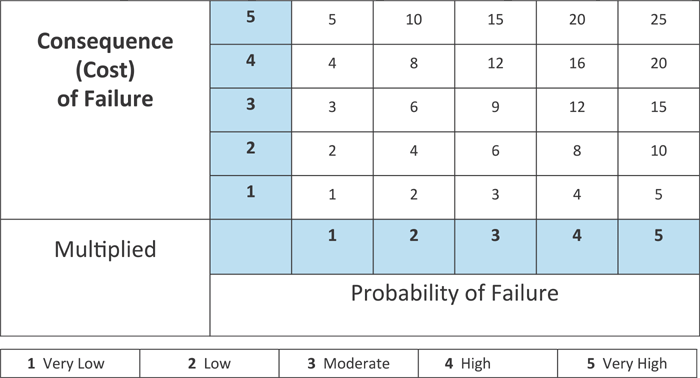
A technique such as the ranking table presented below can be a good place to start in assessing criticality. Appendix C contains copies of this table for use in criticality analyses at your utility.
To use this table, estimate the probability of failure for a specific asset from 1 to 5, with 5 being very high probability of failure and 1 being a very low probability of failure. Then assess the consequence of failure from 1 to 5 in the same manner. Using the number for probability of failure, move across the row until the column associated with the number for consequence of failure is reached. Locate the number that is in the box where the row and column intersect. That is the criticality score for that asset.
Consider the following scenario.
Asset: 10 inch Cast Iron pipe; constructed in 1950, (61 years old in 2011)
Service History: Numerous breaks in the past 5 years
Service Area: Serves 3 major subdivisions, but there are loop lines available and only residential customers are served
Probability of failure: 4 – because pipe has broken many times, but when repaired it was still in reasonable condition
Consequence of failure: 2 – because there are loop lines so not all customers will be out of water. Repair costs are moderate. Line isn’t in a critical roadway so repair is relatively easy.
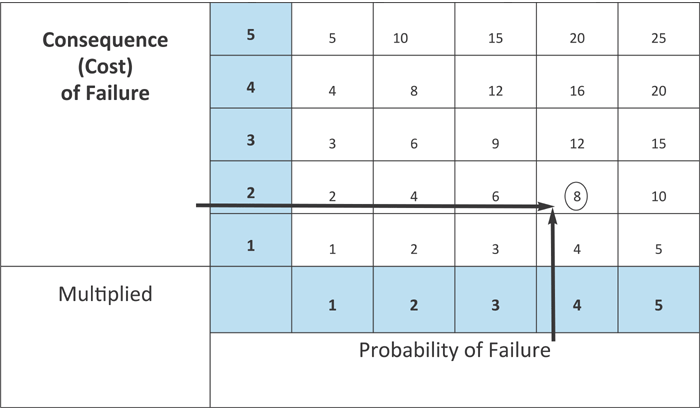
Using the chart, move across the row for 2, until the column for 4 is reached. The number in the box is 8. Therefore, 8 is the criticality factor for this asset. (See the table below.)
As another example, look at the following scenario.
Asset: Chlorine pump
Utility uses hypochlorite so liquid chlorine solution is pumped into the utility for disinfection. Utility has both spare parts and a spare pump. Chlorine pump has failed due to many factors several times in the past 10 years. Chlorine is checked once per week.
Probability of failure: 4 – because pump has failed many times
Consequence of failure: 4 – because a failure in a chlorine pump has the potential to be a major consequence. The consequence is mitigated by the presence of a spare pump and spare parts. However, because the pump may fail for a significant period of time before the failure is known (up to 1 week because the levels are only checked once per week), the consequence is not substantially reduced by the spare parts and pump.
Using the chart, move across the row for 4, until the column for 4 is reached. The number in the box is 16. Therefore, 16 is the criticality factor for this asset. (See the table below.)
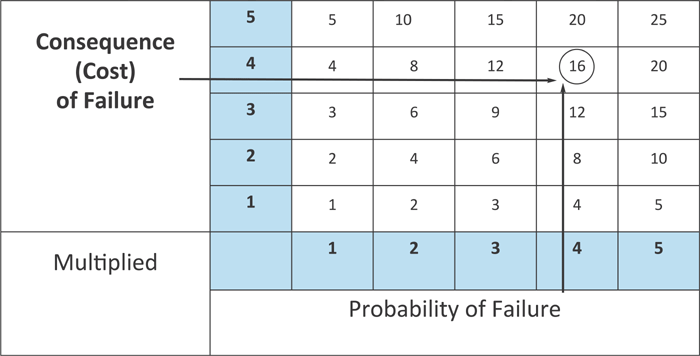
In looking at these two assets for this utility, the chlorinator is much more critical than the piece of pipe. If all assets are viewed in this way, an analysis can be done to determine the criticality number for each asset and then the results can be compared to see which assets are more critical than others.
Once an analysis of this type is done, the results can be reviewed to determine if they make sense to the utility. If the utility personnel do not believe the results for a particular asset make sense (i.e., the asset seems to have the wrong relative ranking), a re-evaluation can be completed until reasonable results are achieved.
When the risk assessment for each asset has been completed, a graph showing the risk for each asset is a useful tool to quickly see which of the assets is most critical. Plotting the risk number on a graph with probability of failure on one axis and consequence of failure on the other axis is the easiest way to accomplish this. The graph can be divided into four categories of risk, as shown on the risk matrix (or “quad chart”) below.
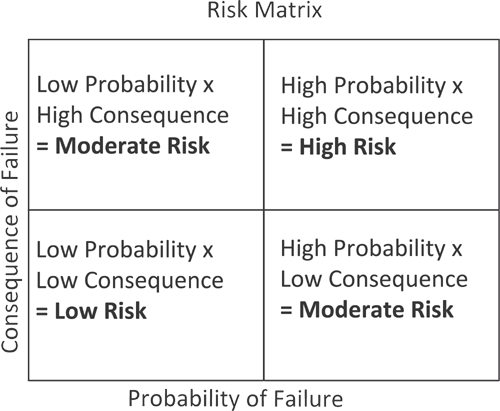
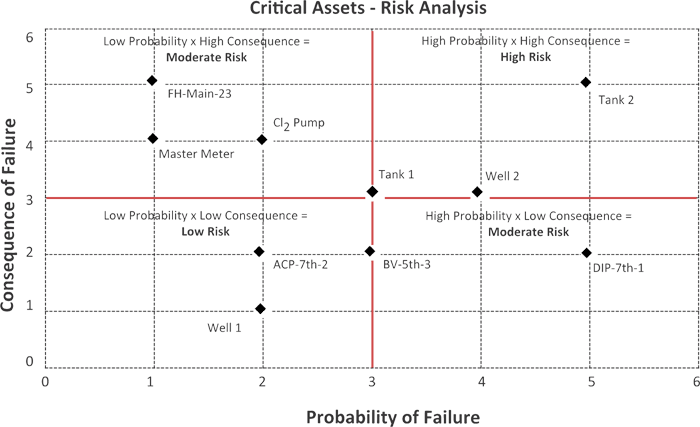
The highest risk numbers will fall in the box in the upper right-hand corner, making it easy to compare assets and determine which of the assets are most critical. An example is shown above that includes assets in each of the quadrants of the chart. This example assumes that redundancy has been taken into account in the consequence of failure rating. A blank quad chart is included in Appendix C.
There is another way to consider redundancy. In this approach, the probability score is multiplied by the consequence score and then by a redundancy factor. The redundancy factor is based on how much redundancy there is for the asset. For example, if there are three pumps and two are needed to operate at a time, the utility has a 50 percent redundancy in pumps. If there are four pumps and three are needed, the utility has 33% redundancy. If there are two pumps and only one is needed, there is 100% redundancy. If there are three pumps and only one is needed, there is 200% redundancy.
An example of how to calculate the risk ranking using this approach follows.
A pump is rated 4 for probability of failure and 4 for consequence of failure. There are 3 pumps and 2 must be operating at any one time. (50% redundancy)
Criticality = (probability rating) times (consequence rating) times (1 minus redundancy factor expressed as a decimal)
Criticality = 4 X 4 X (1 – 0.5) = 8
Note that without redundancy, the asset would have had a score of 16.
If the redundancy is 100% or more, the equation would give an answer of 0 or negative risk. However, this does not represent the true risk, because even with redundant assets, there is still some risk related to the asset because the redundant assets must perform as expected. Therefore, for any asset that has a redundancy of 100% or more, a consequence rating of 1 should be used.
Criticality…is the probability of failure and the consequence of failure.
—Frank Roth, Albuquerque
5.6 Criticality Related to Energy Use
Another component to consider when assessing which assets are critical to the process is energy use. If the asset is a high energy user, there is an operational cost associated with that energy use. Ranking assets according to energy use in a manner similar to the condition and consequence rankings will allow energy to be a consideration in the overall process of criticality.
There are many factors to consider when assessing criticality related to energy efficiency. Most of these factors fall within two major headings: the asset’s impact on energy use, and the feasibility of addressing the energy use of the asset through installing a new asset or some other method. Discussed below are criteria that can be considered.
When an asset uses energy – either directly or indirectly – its impact on energy use and energy efficiency goals should be considered. The following criteria describe some of these considerations.
- Meets Energy Efficiency Goals:
When determining criticality for energy purposes, it is important to discuss whether the asset currently contributes to meeting the utility’s energy goals or whether it is a factor in not meeting the goals. If the asset is allowing the utility to meet its energy goals, it should be given a low score (i.e., low criticality) and if it is not meeting the energy efficiency goals it should be given a high criticality score. - Energy Use:
If an asset uses large amounts of energy, there may be a potential for significant energy use reductions related to installing a more energy efficient asset. If the asset uses very little energy or the asset is already as energy efficient as practical, there may be little potential for reducing the energy use. Assets that have a high energy usage should be given a higher rating than assets that have a low energy use. This evaluation should use actual energy use data when available. - Renewable Source of Energy:
When considering energy use, understanding how the energy source impacts the environment may be an important part of the energy criticality evaluation. If an asset is a significant contributor to greenhouse gas emissions it may be given a higher rating. If an asset uses a renewable energy source, it would be given a lower ranking.A table showing a 1 to 5 ranking system is presented below.
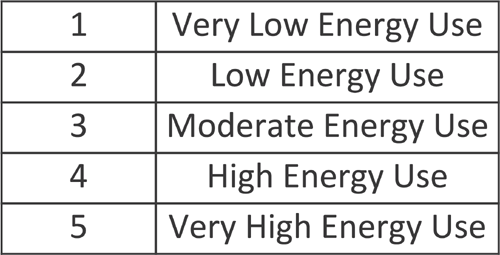
The second aspect of the criticality discussion for assets that use energy is the feasibility of addressing the energy use. For the utility to be able to address the energy use of an asset, there must be a feasible alternative to the current asset, or a more efficient way to operate it, or a different energy source. The more feasible the project is, the higher the ranking should be. The less feasible, the lower the ranking.
- Potential Alternatives:
When deciding if the asset’s energy usage can be reduced, consideration must be given to whether there are potential alternatives to the current asset. For example, an asset may be 65% efficient and the utility may desire it to be 75% efficient, but this increase is not possible if there is not a replacement asset on the market with that efficiency rating. Consideration must also be given to operational changes that may be required by the alternative. The more feasible a potential alternative is, the higher the criticality ranking score. - Costs:
There may be alternatives to the asset as described above, but both capital and operational costs of the alternative(s) must be considered. Additionally, any cost savings that will result from the reduction in energy usage should be taken into consideration. The operational cost savings can be compared to the capital cost to determine how long it would take in savings to pay for the capital. The shorter the period, the better the project. The energy source of the original asset and any potential alternatives should be considered as well. When converting from one source of energy to another (i.e. electricity to natural gas) the operational costs may be significantly impacted. Any non-monetary costs – either positive or negative – should also be considered, such as social and environmental costs. The lower the costs or the greater the energy savings, the higher the criticality ranking. - Availability of Funding, Financing or Rebates:
The question must be asked, How can the potential energy reduction alternative be paid for? If funding is available or if there are specific rebates or other incentives in the funding for the alternative, the project criticality ranking is higher. - Operability:
Is it possible for the alternative to be operated with current staff upon completion? If the answer to this question is yes the ranking should be higher and if the answer is no, the ranking should be lower. - Regulatory Requirements:
If an alternative is required to meet new or existing state or federal regulations or to address non-compliance, it should be given a higher ranking.
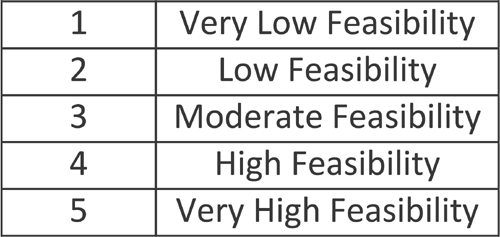
Similar to the approach with probability of failure and consequence of failure the assets can be ranked according to energy usage and ability to address the energy usage. The assets can be given a score of 1 to 5 for energy usage and a score of 1 to 5 for the potential to address the energy usage. The assets with the highest scores would be those that have both high energy usage and high ability to do something about it. These assets would be “critical” from the standpoint that if the asset were replaced or rehabilitated in some way related to energy, the utility would benefit.
When the factors for energy use and feasibility have been considered, a matrix similar to the one in section 5.5 can be constructed.
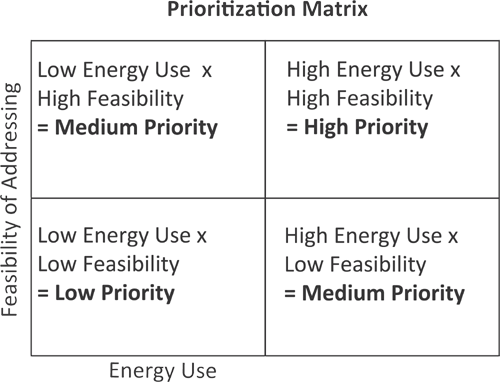
The same ranking tables and graph from above can be used with energy projects.
Consider the following example.
Asset: A Sewage Lift Station Pump
Energy Usage: Uses a large amount of energy, representing 20% of the total energy usage for the utility. It is causing difficulties for the utility in terms of meeting its goal of 10% overall energy reduction. The pump is 15 years old and there are more efficient pumps available.
Energy Use Rating: 4
Feasibility: The reduction in energy use will offset the cost of the new pump in 6 years. The new pump will be easy to operate by the existing operator. There are funds available that include a grant portion to do this project.
Feasibility Rating: 4
As can be seen on the table, the total energy risk or criticality is 16. That number means that the project is a critical project to consider because it will reduce energy use, save money, and it is feasible. A copy of the table is included in Appendix C.
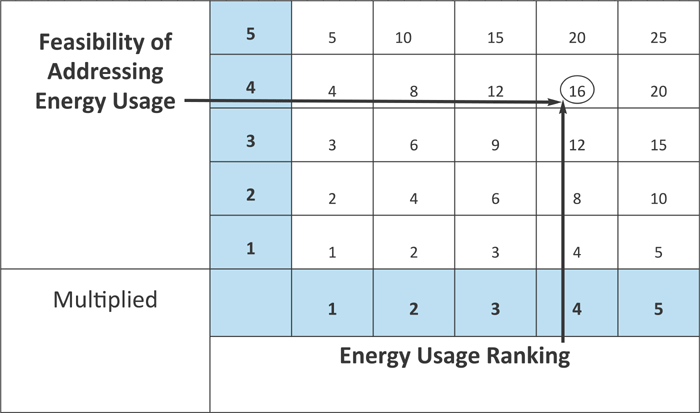
The Energy Use Ranking and the Feasibility of Addressing Energy Use of an asset can be plotted onto a quad chart along with other assets to show the relative merits of addressing the energy issues with each asset. A quad chart for this example is shown below
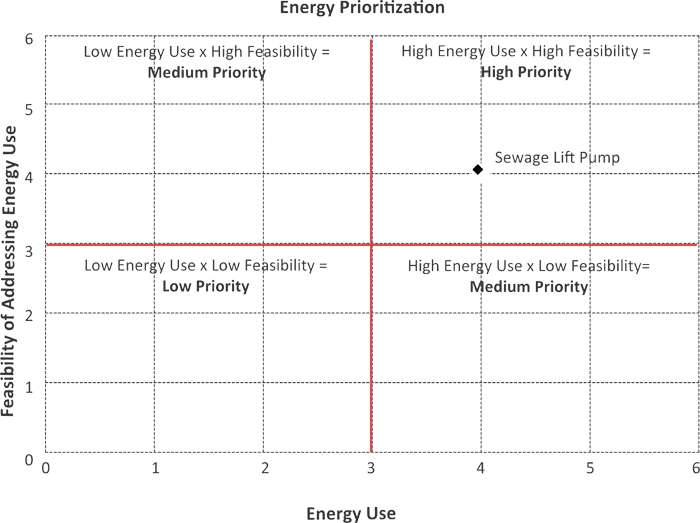
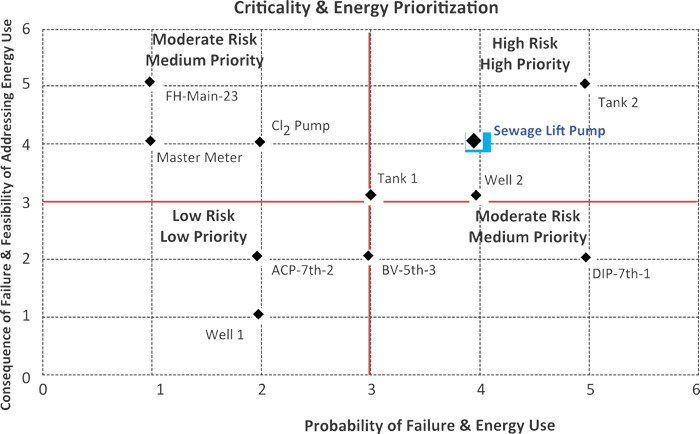
The energy criticality can be overlain on top of the asset overall criticality as shown on the Criticality and Energy Prioritization Chart. If the Sewage Lift Pump was also a high risk asset based on probability of failure and consequence of failure, it would be an extremely critical item for the utility to consider. If it appears critical only based on the energy considerations, it should be included within the context of all highly critical assets.
Overlaying the criticality of assets based on probability and consequence with energy criticality can identify assets that may be high in both categories. These assets would be extremely critical to the utility in terms of replacement. A discussion of decision making based on criticality is presented in Chapter 6. Both of the energy-related quad charts are available in Appendix C.
5.7 Criticality Analysis Over Time
The condition of the assets will change over time affecting the probability of failure. Costs of repair may increase, the community may grow, new roads may be built, rehabilitation may be completed or similar factors may occur that cause the consequence of failure to change. Therefore, it is necessary to periodically review the criticality analysis and make adjustments to account for changes in the probability of failure and the consequence of failure.
The criticality analysis must be reviewed and updated periodically to ensure that the utility is spending its time and resources on the appropriate assets. This operational and managerial approach is the heart of Asset Management. Ways to implement this approach are discussed in the next chapter. The update must also incorporate replacement of assets. If an asset that was critical primarily due to its probability of failure is replaced with a new asset, the criticality number will go down since the probability of failure is much less. The update must also take into account any changes in redundancy – positive or negative. If a new asset was installed to create redundancy, the consequence ranking will go down. If a redundant asset has failed and has not been repaired or replaced, the redundancy has decreased and the consequence ranking of the asset may increase.
You do your interventions and your asset replacements based on your ability to live with the risk.
—Ross Waugh, New Zealand