
3.1 Current State of the Assets – Introductions
The first core component of Asset Management is assessing the current state of the assets. This component is probably the most straightforward. It is also, arguably, the most important as it underlies all other aspects of Asset Management. This step is critical to improving the water or wastewater utility’s understanding of its system. Completing this step alone can greatly improve the overall operations and management of a utility.
This core component involves gathering information on the following basic questions:
- What assets do I own?
- Where are they?
- What condition are they in?
- What is their remaining useful life?
- What is their value?
- What type and amount of energy do they use?
Get a handle on what you have
-Eric Saylor, Cincinnati, OH
After the key information on assets is gathered, it is important to create an asset inventory to store the data. This inventory will need to be maintained to ensure it is kept up to date and accurate. The utility may also want to establish a work order system that is tied to the asset inventory to manage asset maintenance and repairs and to track the costs of these activities over time.
3.2 What Do I Own?
The most fundamental question a utility owner, manager, or operator can ask, is what assets does the utility own? It is absolutely critical to understand what you own. It is hard to manage something effectively if you don’t know what that “something” consists of. Although “what do I own” is a seemingly straightforward question, it is not always easy to answer. The difficulties arise from several factors. Some of the assets are underground and can’t be seen; assets are put in over a long period of time; records regarding assets may be old, incomplete, inaccurate, or missing; and staff turnover in operations and management may limit historical knowledge of utility assets. Given these difficulties, it may not be possible to immediately create a complete inventory of all the assets in the utility. It is important to recognize that the goal is to create the best inventory possible given the resources (personnel and financial) and capabilities of the utility and to develop an approach to adding to or improving the inventory over time.
In determining the answer to the question, “What do I own?” consideration must be given to how to specifically define an asset. In general terms, assets are anything that you own that has value. However, this definition must be refined for a given utility. Some utilities may want to define assets in terms of dollar amounts. An asset could be defined as anything above $1,000 or $2,000 or any other amount that makes sense for the utility. In selecting this value consideration should be given to the total number of assets owned by the utility and the ability of the utility to track the number of assets that will result from the selected dollar amount. For example, defining an asset as anything with value over $500 may result in 2,000 assets for the utility, while selecting a value of $3,000 may result in 400 assets for the utility. Both choices are equally valid options, but it may be too difficult to track 2,000 assets for a utility with a small staff, or it may not provide sufficient benefit to the utility to track assets with such a low dollar value.
You don’t want everything in there.
—Stacy Gallick, Johnson County, KS
On the other hand, choosing $3,000 may leave important assets out of the inventory or may not provide detailed enough information to manage the utility effectively. A value in between these two amounts may provide sufficient detail without being unduly burdensome.
Another way to answer the question of what defines an asset, is to define an asset as anything the utility would write a work order for. For example, if the utility would write a work order on a pump impeller if that part needed repair or replacement, then the impeller itself can be defined as an asset in addition to the pump it is a part of. If the utility would only write a work order for the pump, but not the impeller, then the impeller is not considered a separate asset.
These two approaches – dollar value or work order – or some combination of the two are the most common methods of establishing what defines an asset. Each entity should establish its preferred method of defining an asset. The main considerations include ability to handle the number of assets that results from the chosen option and being able to consistently apply the approach. The selected approach can be modified over time if it does not meet the needs of the utility.
Consider the example of Old Forge, NY. This utility selected a dollar amount of $500 to define an asset and then determined that this approach resulted in more assets than they could effectively track. For this utility, assets of that value could be replaced within the operating budget and did not need to be tracked. There was insufficient benefit for the utility to track assets at this dollar amount. Old Forge subsequently raised the dollar amount to define assets as anything valued over $1,000.
We soon realised that was not realistic.
—Ted Riehle, Old Forge, NY
3.3 Obstacles
Once you know what assets you own, it is important to know where they are located. This component involves mapping the assets that are in the field and recording the location in the inventory file.
The most important factor in mapping is having a visual picture of the asset locations, especially for buried assets. The map can be as simple (hand drawn) or as complex (Geographic Information System) as the utility is capable of. The inventory map can help operators, managers, elected officials, and owners conceptualize the utility as a whole.
The most important considerations in selecting the type of approach to use for mapping are:
- Ensuring that the map is comprehensive (covers all the known assets)
- Having the ability to keep the map updated over time
- Establishing a process to correct any inaccurate or incorrect data on the map
- Being able to track asset failures or other relevant data on the map
A utility should choose the type of mapping system that best meets the needs, capabilities, and resources of the utility. Choosing a more sophisticated computerized mapping system, like GIS (geographic information system), has the benefits of being able to more easily sort and evaluate data, linking asset attribute data (size, type, condition) to the map, enabling remote use, and more accurately representing the data. However, this type of system can be expensive to create and maintain and the utility may not have the personnel to handle this task. A more simplistic approach of a hand-drawn map or a hand drawn map based on a free base map from an internet site (e.g. Google, MapQuest, Bing maps or similar), has the advantages of being extremely low cost and easy to generate. But this type of map is much less portable, less comprehensive in terms of asset data, and less accurate. The key is to balance the needs of the utility, the benefits the utility wishes to achieve, and the resources available for the task. A utility can also start with simpler maps and move to a more sophisticated approach later.
When thinking about mapping, a utility should also think very creatively for potential reduced cost options to access computer mapping expertise. Potential options include community college, university, or high school students who have taken courses on GIS mapping who may be willing to work as an intern to gain experience in mapping. Or perhaps a college or high school class would consider taking on a utility map as a class project. County, city, or state governmental agencies may offer free base maps or they may be able to assist with developing a map.
Data on locations can be gained by using a global positioning system (GPS) device. Simple versions of these devices can be purchased at many retail stores for very little cost and they are designed to be user friendly and simple to operate. These types of devices can be used to gather point data for visible assets (such as hydrants, manholes, valves, wells, storage tanks, pump stations, storm drains) and line data for water or sewer pipes. The accuracy of the simple devices is sufficient to create a reasonably accurate picture of the utility and can be adequate for most smaller utilities. A larger utility may wish to have higher accuracy GPS readings and could invest in more sophisticated GPS equipment or hire outside consultants to compile this information.
It gives you a picture of how your structure is laid out.
—Scot Jaynes, Tucumcari, NM
In terms of gathering data for the map, it is best to start with what is already known about the utility from any maps – hand drawn or otherwise – that the utility has. The utility may have “as-built” drawings or maps that show assets that were installed during construction projects. These maps are intended to provide accurate information regarding the assets that were installed during the project. However, they may be limited in terms of scope in that they may show only the newly installed assets and not a comprehensive view of all the assets in the utility, and they may not be entirely accurate. Current operators and managers and retired operators or managers can work to fill in as many gaps in the information as possible. Additional gaps might be filled in by residents who were living in the area when the utility was built, or by engineers or construction contractors involved in the design or installation of the utility.
It is important to remember that no map will ever be completely accurate, especially in the initial stages. You should strive to make as good a map as possible the first time, within the limits of the information available, and then improve upon it. A good time to make any changes to a map is after assets have been dug up for a repair. At that time, any inaccuracies in location can be corrected. In addition, whenever new assets are installed, accurate locations can be obtained and added to the map. It is not recommended that assets be dug up for the sole purpose of locating them, unless there is a very compelling reason to do so. Instead, take your best guess at locations and revise as you learn more to keep the map as up to date and accurate as possible.
Additional information regarding internet-based mapping options can be found in Appendix A.
Some assets, such as pipes, will be mapped as described above while others, such as assets located in buildings, may not be mapped. In either case, the asset location should be added to the inventory file. Generally, the location will be a street name, street address, or building location such as pump house or treatment building. The addresses should be as specific as possible so that assets can be grouped together based on their location. It is important to be able to group assets by their category (i.e., all valves, all hydrants) and by their location (all assets on Main Street.) In this manner, the utility can answer various questions about its assets, such as: “If I replace the pipe on main street, what other assets are associated with that pipe that will also have to be replaced?” “If I replace a component in the treatment building, what other assets might be impacted?” Methods of including data in an inventory are discussed further in Section 3.8.
3.4 What is the Condition of My Assets?
After the assets are identified and located on a map, it is important to know their condition. A condition assessment can be completed in many different ways, depending on the capability and resources of the utility. The simplest approach is to gather people who have current or historical knowledge of the assets in a room. The group can then select a condition rating approach (0 through 5, A through F, Excellent through Unacceptable, etc.). The group then considers the list of assets and rates each one using the selected methodology. This approach relies on the best information available but does not require utilities to gather additional data in order to rate the assets. Any condition rating system that is understood by the utility and that is consistently applied is acceptable. A condition rating system should be agreed upon before rankings are made and a pilot project can be performed using a small subset of assets to test the effectiveness of the chosen ranking system. Each asset in the pilot project is ranked based on condition, and then everyone can examine the results to determine whether they make intuitive sense and if the selected approach was easy to use. If needed, the condition rating system can be revised and the pilot repeated. Once the condition rating system is selected it should be used consistently throughout the utility.
Examples of ranking systems are presented in Appendix A.
When you look at condition…the more people you have involved, the better.
—Ted Riehle, Old Forge, NY
At a higher level or as a next step after the initial ratings of the assets, utilities can gather data on asset condition through more sophisticated means and re-rate the assets. For example, a sewer pipe can be examined with cameras to determine the interior pipe condition. Water pipes can be evaluated using leak detection technology. A rating system as described above may still be used in combination with this higher-level data, or a more sophisticated numbering system can be used.
We have a numbering system. They’re almost all 1 to 5.
—Stacy Gallick, Johnson County, KS
Asset condition will change over time as assets age and as they are used during normal operations. Therefore, the asset condition must be continuously updated to keep the data current. The time interval between updates may vary from utility to utility, but generally annually is a good time to revisit the condition assessment. In addition, as assets receive routine, preventative, or corrective maintenance, condition can be re-assessed and the resulting condition rating can be revised in the inventory.
Examples of the types of condition monitoring approaches that can be used to assess asset condition is presented in a table in Appendix A.
3.5 What is the Remaining Life of My Assets?
All assets will eventually reach the end of their useful life. Some will reach this point sooner than others. In addition, depending on the type of asset, it will either reach that point through amount of use or length of service. For example, a pump will wear out sooner if it is used more and will last longer if it is used less. The actual age of the pump is not as important as the amount of work the pump has done. On the other hand, the life expectancy of pipe assets is based more on the length of time in the ground. If a pipe is in the ground for decades, it has had considerable time to contact the soil around it and the water within it and may start to corrode.
There are many additional factors that will affect how much life a given asset has. Factors such as poor installation, defective materials, poor maintenance, and corrosive environment will shorten an asset’s life, while factors such as good installation practices, high quality materials, proper routine and preventative maintenance, and non-corrosive environment will tend to lengthen an asset’s life. Because of these site-specific characteristics, asset life must be viewed within the local context and the particular conditions of that utility. Cast Iron pipe may last 100 years at one facility and 60 years at another. It is best to make judgments on asset life based on past experience, utility knowledge, existing and future conditions, prior and future operation and maintenance, and similar factors in determining useful life. In the absence of any better information, a utility can use standard default values as a starting point. These default values can be obtained from manufacturers and industry guides. However, over time, the utility should use its own experiences to refine the useful lives.
For example, if a given water utility routinely replaced its chlorinator every 5 years because that was as long as that asset lasted, then 5 years should be used as chlorinator life, instead of a standard default value. However, if the utility has had its pipe in the ground for only 20 years and has no knowledge of how long it could be expected to last, it could use a standard default value of 50 to 75 years. However, as time goes on, if the utility did not notice any reduction in the integrity of the pipe after 40 years, the useful life could be increased from 50 years to 75 or 100 years. If the utility started seeing a reduction in the pipe integrity (numerous breaks due to corrosion) at 40 years, it would keep the useful life closer to 50.
Additional information regarding estimated default values for useful lives is contained in Appendix A.
3.6 What is the Value of the Assets?
Generally, when utilities consider the value of assets, they think about the cost of initially installing the assets. This cost has importance as historical information or it can be used by a utility to depreciate the costs of assets over time. It can also be useful to determine the total costs of operating an asset over its life span. However, the installation cost does not have a direct bearing on what it will cost to replace that asset when it has reached the end of its useful life. The asset may not be replaced by the same type of asset (e.g., cast iron pipe may be replaced by PVC pipe) or it may be replaced by a different technology entirely (e.g., a chlorination system replaced by an ultraviolet disinfection facility). Furthermore, costs of various assets may change drastically over time, so that the cost of installing ductile iron pipe in 1965 may have no relationship to the cost of installing PVC pipe 50 years later in 2015.
The value of the assets that should be recorded in the asset inventory, then, is the cost to replace the assets using the expected technology that will replace them. If the utility has asbestos cement pipe now, but would replace it with PVC pipe, the replacement value of that asset is the cost of replacement using PVC and the installation costs associated with PVC.
Although the idea behind valuing assets is relatively simple, obtaining costs for the asset replacement may not be so easy. Small utilities may not have the expertise to estimate replacement costs. In these cases, the utility should either estimate in the best manner possible or leave this portion of the inventory blank for the initial stages of the asset inventory. This information can be added later as the utility gathers additional information or expertise.
You need to come up with an average replacement cost.
—Ross Waugh, New Zealand
If estimation is done, the possible approaches include:
- If the utility has had recent improvements, such as pipe replacement, information regarding the cost per linear foot can be used.
- If a similar neighboring utility has had work done, costs incurred in their project may be used.
- Organizations that complete a large number of construction projects per year may be able to provide estimates.
- Some organizations, such as large cities, periodically publish unit costs for construction. These costs can be used as a starting point and revised as necessary to cover costs in other areas. If costs are typically higher in a particular area than the published guide, they can be increased. If costs are typically lower, the prices can be decreased.
Over time, as more utilities begin completing Asset Management strategies, it might be useful to form users’ groups that would allow water or wastewater utilities to share information, such as unit costs/replacement costs, with each other.
3.7 What is the Energy Use of My Assets?
In addition to the information considered thus far, it is important to consider the energy use of your assets. This question involves a consideration of the asset’s overall energy consumption, the type of energy used, and whether the energy consumption contributes to greenhouse gases. This assessment is important because energy usage is a significant portion of a utility’s expenses, sometimes accounting for as much as 50 to 75% of the total operating costs. Therefore, optimizing energy consumption can have a significant impact on the cost of operating a water or wastewater facility. In order to determine the potential to reduce energy use, energy usage data should be collected for the assets in the inventory. As the assets are being inventoried, data on energy use, such as the following should be collected, to the extent possible:
- Type of energy used
- Horsepower
- Variable or constant speed
- Design specifications
- Operating status and practices
- Hours of operation per year
- Average equipment run times
- Measured power consumption
- Peak energy demands
- Total kilowatt-hours (kWh) of electrical consumption
The best method of gathering information about energy use by an individual asset is actual metered energy usage. However, most utilities don’t have energy meters on each piece of equipment that uses energy and some utilities may only have one master energy meter that indicates overall energy use. In these cases, estimates will have to be made of asset energy use based on load, performance factors, equipment efficiencies, operator experiences, manufacturer’s data, and reference guides. A particular reference guide that may be helpful is EPA’s Energy Star Program.
…one of the things we’ve found is a limitation.. at the water plant, there is one master meter.
—Barry Kirchhoff, Columbia, MO
In considering overall energy use, it is important to look beyond those assets that are easy to identify as energy consumers, such as pumps, motors, blowers, and drives, to those assets that have a less obvious effect on energy use. For example, leaking pipes have an impact on energy use because they result in more water being pumped and treated than is needed by the customers. Other energy use may come from “assets” that are not included in the inventory, such as light fixtures or heating units in buildings or pump stations or the gasoline or diesel usage of the utility’s fleet of vehicles. It is important to have a method of capturing this type of energy use in your overall baseline assessment of total energy usage.
There are multiple area of energy use.
—Russell Batzel, St. Peters, MO
3.8 Developing An Asset Inventory
Once the answers to the questions in the previous sections are determined (what do I own, where is it, what condition is it in, what’s its useful life, what’s its value, what type and how much energy does it use) the information must be organized in an asset inventory. This step is important, but it should not be allowed to become all-consuming and utilities should not get “bogged down” in this step. The utility should complete this step to the extent possible in a reasonable amount of time and then move on. Alternatively, the utility could do the inventory a little bit at a time while working on the rest of the Asset Management program.
There are a number of systematic approaches to developing the asset inventory, such as collecting data one type of asset at a time (e.g., all the pumps, then all the hydrants, then all the valves), collecting data on one portion of the utility at a time (e.g., pre-treatment, then treatment, then solids handling), collecting the data linearly from one side to the other, collecting newer assets first (where there’s likely to be more readily available information) followed by older assets, or collecting the data based on year of installation or based on major construction projects (this approach could be based on as-built drawings the utility has of each of its major construction efforts). Any of these approaches or any other approach that works for the utility is fine.
During the initial data collection effort, it is highly likely – and expected – that there will be gaps in the data. Some information may be missing, such as the manufacturer or the installation date or the value of the asset. During the initial inventory process, care should be taken to ensure that the best data possible is put into the inventory and reasonable estimates can be made for items that are missing. For example, if the installation year for pipe is unknown, the installation date of surrounding pipe may be used or if the construction date for a neighborhood served by the pipe is known, that date can be used. If no other data is available for installation an estimate of the oldest time of installation or an average date of installation may be used. The main point is to collect the best and highest quality data given the available resources of personnel, time, records, and technology during the initial survey. and then allow data quality to improve later.
The sophistication of the asset inventory can be increased over time. The utility may start out with a simple approach and improve upon that as resources become more available. The most important thing is to just get started with the inventory. Anything the utility does towards cataloguing what it owns in a systematic fashion will improve overall management of the assets and decision making.
3.8.1 Collecting Data On Assets
To develop the initial inventory, several approaches can be used and these are listed below. However, the utility should be as creative as possible with other approaches to obtaining this information.
- Determine who operated, managed and/or owned the utility at the time of the major construction periods (when a large number of assets were put in.) Interview these individuals and gather as much information as possible regarding their recollections of what assets were installed and where they were installed. If there are maps of the utility, these can be used during the discussions.
- Examine any as-built or other engineering drawings of the utility.
- Perform visual observations of above-ground or visible assets (e.g., hydrants, pumps, manholes, treatment works).
- Use a digital camera to take pictures of the assets that are visible.
- Interview community residents who may have lived in the area during construction and who are familiar with the construction activities (especially helpful in very small towns in which the residents were actively involved in developing the utility).
- Interview contractors or engineers that were involved with construction.
- Estimate buried assets using above ground assets as a guide (e.g., using manholes to estimate locations, size, and type of pipe between the manholes; using isolation valve locations to estimate buried water pipe locations).
- Examine photographs of the utility taken during construction, repair, etc.
- Consult USGS Topographic Maps and other non-utility generated maps.
- Examine aerial photographs – both recent and historical.
- Use existing inventories (fire hydrants, meters, valves, etc.).
- Use metal detectors to locate buried assets.
- Consult utility records: billing, repair, maintenance, inspection, O&M manuals, sampling, operator’s log/notebook, etc.
- Consult state and/or federal records, databases, or employees for information such as well depths, drill dates, discharge information, etc.
Several approaches may be necessary to get a good start on the asset inventory. A utility should use as many approaches as it deems necessary to get the best initial inventory of assets.
An obvious question when gathering data for an asset inventory is how much time will it take to gather the asset data? The answer will vary from utility to utility based on the overall number of assets, the number of utility staff, the overall area covered by the assets (size of community for water or wastewater pipes), and the quantity of data being collected on each asset. Gathering data can be a time consuming activity, but it is manageable if it is done in a systematic way or completed in phases.
We could actually speed up the process…if we just came out and took a picture.
—Mark Winslow, Albuquerque, NM
3.8.2 Asset ID Numbering
In developing an asset inventory, it is critical to develop a unique asset identification number (Asset ID) for each and every asset in the inventory. This number can be anything, as long as it is unique; however, it is preferable to use a “smart” numbering system. The smart numbering system can contain identification information for location, equipment type, equipment function, and specific piece of equipment. The numbering system should be consistent throughout a facility and should be easily and quickly recognized by facility personnel.
The numbering scheme should be developed by the individuals who will have to use it most, or at least should be developed with input from these individuals. In some facilities, a small number of individuals will need to be familiar with the ID numbering scheme or understand it, while in larger facilities, multiple people or departments will need to understand and use the scheme.
The task of developing an asset ID numbering system can seem simple, but in practice can be quite complex. It may be necessary to revise the system a few times before it is satisfactory. The best approach is to think about what should be accomplished with the numbering system, discuss different approaches, select an approach, and then do a pilot project to see if it will work properly. The pilot project should include a small subset of the overall assets from different parts of the facility to determine if the numbering system that was selected will work. If the numbering scheme does not perform adequately, it can be modified to solve the issues and the pilot can be repeated.
Numbering Scheme Example:
An example of a potential numbering scheme is shown below. Additional examples are contained in Appendix A.
Example 1:
A BCD EFG 1
A = Water (W) or Wastewater (WW)
BCD = facility name (i.e., abbreviation for pump station, well house, treatment building)
EFG = Equipment name (i.e., abbreviation for name of equipment)
1 = Equipment number (i.e., number for that particular piece of equipment)
For Example:
WMPSPMP1 = Water System Main Street Pump Station Pump 1
W = Water System
MPS = Main Street Pump Station
PMP = Pump
1 = Number 1 Pump
Any numbering system that provides location and equipment identification and that is unique for each asset can work. The system chosen should be one that best fits the particular utility. It is worthwhile to examine approaches used by other utilities in selecting a numbering scheme, but the system must be modified to suit the individual needs of the utility.
Once asset IDs are established, ID tags can be placed on visible equipment (pumps, valves, hydrants, blowers, etc.) The tags should be durable and attached in a semi-permanent way. If tags become warn or knocked off the equipment, they should be replaced.
3.8.3 Asset Hierarchy: Which Assets Go Together
Within a water or wastewater utility, there are natural groupings of assets. One asset is typically a component of a larger system of assets. If assets are entered into the asset inventory in such a way that these groupings are recognized, it is a lot easier to examine asset data and make decisions about asset repairs and replacements. This type of grouping is called an asset hierarchy. The hierarchy can also be thought of as a tree structure or a parent, child, grandchild structure. An example of a portion of the hierarchy of a water utility is presented below.
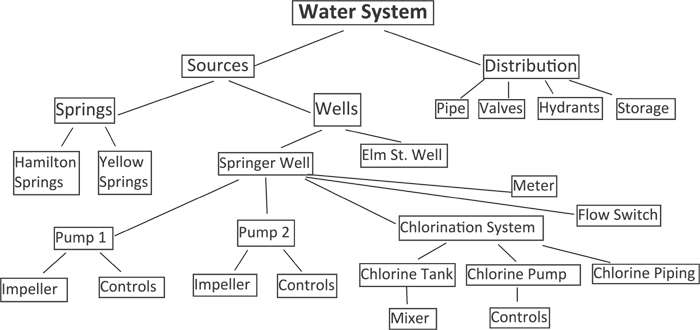
The asset at the top of the list is the parent asset, the next level is the child asset, the next is the grandchild asset and so on. If you start at the bottom, assets can be “rolled” up into higher and higher categories until the final level is all of the assets in the water utility (or wastewater utility.) If you have multiple water or wastewater facilities that are completely independent of each other, each one of those can be a parent asset category or the parent can be water (or wastewater) with the child asset the name of each of the independent systems as shown below.
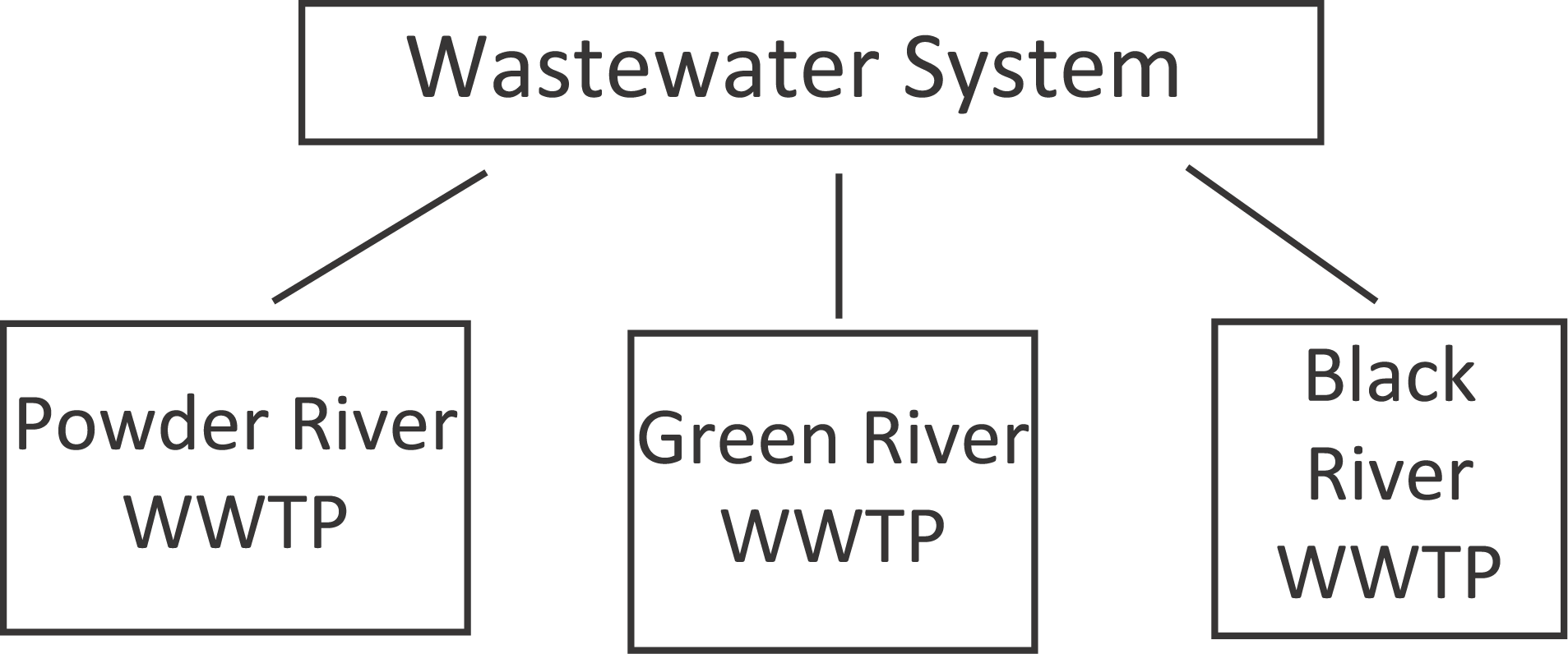
Then all of the assets for each plant can be associated with the individual treatment facilities.
The benefits to an asset hierarchy are to be able to develop costs for groups of assets, such as the total cost of pre-treatment, the total cost of well #1 or the total cost of all wells. If the costs associated with individual assets associated with wells are collected, then the costs of these assets can be rolled up to obtain the cost of an individual well or all wells.
It was a lot of discussion and dialogue.
—Dereck Sherry, Platte City, MO
3.8.4 Data: How Much and At What Cost?
There is almost an unlimited amount of data that can be collected on assets. Clearly, it is neither possible nor cost-effective to collect every piece of data that could be collected on an asset. How much data and what type of data to collect on the assets should be determined based on a consideration of the following:
- How will the data be used?
- What data is important to upper management/elected officials?
- What resources are available to collect the data?
- Can the level of data be kept up over time?
- Can the accuracy and quality of the data be ensured?
Of these, the most important consideration is the use of the data. Collecting data for data’s sake is not helpful to the utility and spends precious resources in the wrong area. Alternatively, not collecting data that is needed to support good decision-making is equally inefficient and effective.
One of the first steps in the process should be to decide what data will be useful to everyone within the utility, how it will be used, how much it would cost (time and other resources) to collect the data, what the quality needs to be, how easy it would be to collect the data, when the data would be collected and how it would be maintained in the future.
The trick is not to collect too little information…but to collect too much.
—Ross Waugh, New Zealand
This type of discussion should include all levels of the organization from operators to elected officials. The goal should be to collect the data that will be beneficial in asset operation and maintenance and in making management decisions and no more or less data than that. If the data is used, it is more likely to be collected in a high quality manner. If the data is not used by anyone, it is unlikely to be kept up over time or it may not be put in the inventory at a high quality.
3.8.5 Collecting and Storing Cost Data on Assets
In order to make better management decisions about assets – when to continue to repair an asset versus when to replace an asset – cost data on an individual asset basis is needed. This data could include initial cost (if known,) operation and maintenance costs, repair costs, and rehabilitation costs. Additional costs such as fines or legal fees associated with an asset failure can be included if they are known and the inventory program is sophisticated enough to contain this data.
If the utility is using a very simple inventory program such as Microsoft Access or Microsoft Excel, there can be a cost data column or entry that contains the total cost for that asset per year. This could be done by adding new costs to the number that was there and entering the new amount. This approach would not provide a cost history, but it could provide cost information. For example, in October $200 was spent on Blower #1. $200 is entered into the O&M cost entry on the Access database. Then in December an additional $100 is spent on O&M. Now the $200 could be changed to $300 so there is only one entry for cost. Alternatively the utility could add cost columns to a spreadsheet inventory program and have multiple cost entries that can be totaled to determine the overall cost of the asset. For some assets, this approach could result in an extremely large spreadsheet.
A utility can also invest in a more advanced asset inventory program that tracks costs through a work order system or one that has more options regarding how to collect costs.
I was able to track all the costs for that.
—Brianne St. Pierre, Somersworth, NH
3.8.6 Types of Programs for Data Storage
There are many options regarding how to manage the asset inventory data. Specific options include:
- Commercially available software for asset inventories
- Generic database software
- Spreadsheet software
- Hand written inventory
The best option is a specifically designed Asset Management software program. This type of program provides the greatest level of flexibility in terms of use and is already programmed to contain asset inventory data. However, this type of program is expensive and may require a robust computer system to make it accessible to all operational and management personnel. Since this type of software is written specifically for Asset Management, it is designed to allow the input data to be searched and printed, has pre-designed reports, can track budgets, and provide a lot of other useful information. There is a wide variety of programs of this type in a full range of pricing options from free (EPA’s CUPSS program) to extremely expensive. Which program is chosen depends on the features desired and the cost.
The next option, generic database software, is much less expensive but will require a time commitment on the part of someone within the utility to set up the database and input the data. This option will allow the utility to sort the information. Creating a database using generic database software is not typically self-explanatory. However, there are courses available for learning about databases at most colleges or community colleges. Many of these are relatively short and inexpensive. In addition, communities may have a student or someone with database knowledge who would be willing to assist with this project. Once the database is created and tested, maintaining and updating the data can be accomplished by a staff member of the utility who has the time, skills and inclination to do it. Some examples of database software that are readily available include MySQL, Microsoft Access, Oracle, FoxPro, and OpenOfficeBase. This option is recommended for smaller utilities that cannot afford commercial software.
Another method of cataloging an inventory is to create a spreadsheet that lists every asset in the utility”s inventory. Spreadsheet software is standard on most computers. However, there are disadvantages to using a spreadsheet. Spreadsheets have very limited searching capabilities. Creating a spreadsheet inventory will essentially create a list of assets that can be printed. Although spreadsheets have some sorting capabilities, queries such as “Provide me a list of all pipes installed in 1950 that are cast iron that have had at least 1 break in the last 10 years” are very difficult to perform. This list can be obtained in a matter of moments with a database.
If software and computers are not readily available, the utility should have a written inventory of all the assets it owns. This handwritten list should be edited as the utility grows and changes. A handwritten inventory is the least desirable inventory option, but is better than no inventory at all and should be used if this is the only option available to a utility. This method can also be used as an interim option while a utility works toward a computerized system. One option to consider with a hand written asset inventory is to put each asset on an index card so that they can be sorted in a file box. The key to a useful asset inventory is to structure it to provide the information the utility needs in an easy to retrieve fashion. If the data is not easily accessible, the utility will not use it and the inventory ceases to have as much value as it could.
Appendix A contains an inventory form that can be used as a guide for a handwritten inventory or as a field worksheet to gather inventory data.
…it was just the investment of our time in gettin gthe development done.
—Derek Sherry, Platte City, MO
3.9 Updating and Maintaining the Asset Inventory
It is crucial that the asset inventory be routinely updated and consistently maintained. New assets must be added to the inventory as soon as they are installed. Newly discovered assets (such as a pipe that is found during a road construction project or a valve that was paved over that is found in a construction project) should also be added to the inventory. Data on condition, useful life, and value will change over time as the asset ages, is maintained, repaired, or rehabilitated. These changes need to be reflected in the inventory.
Assets that are repaired or rehabilitated through the normal operation process can be revised within the inventory files throughout the year. Other assets that have not been examined, should be revised every year or two to make sure the asset inventory remains up to date and accurate.
If maintaining the inventory becomes such a burden that the quality and quantity of data can not be kept up to date, the utility has a few choices:
- Increase resources (personnel or money) to allow for the additional data collection
- Reexamine the definition of an asset to reduce the overall number of assets
- Reduce the overall amount of data that will be in the inventory (see Section 3.8.4).
The most important consideration is that the data in the inventory be of high quality and be beneficial to the utility, so having less data is better than more data, if the data is of higher quality.
3.10 Work Order Systems
A major function of a water or wastewater utility is to assign operators operation and maintenance tasks and repair orders. A system that describes these tasks is called a work order system. If this type of system is computerized it is called a computerized maintenance management system or CMMS. A work order system – computerized or otherwise – can be a valuable tool for a water or wastewater utility. Very small utilities may find it difficult to manage a computerized system or may not see sufficient benefit to doing so. For all others, a computerized work order system may be highly beneficial in scheduling work, tracking costs, ensuring maintenance is performed on schedule, and determining what parts were used during the repairs.
A work order system can be tied to an Asset Management inventory program so that the information put onto the work order comes from the asset inventory and so that following the completion of the work order, the information from the repair goes back into the asset inventory. These systems can be relatively simple or highly complex. Costs of these types of programs also vary widely. If a utility is considering purchasing an asset inventory software, some consideration should also be given as to whether the utility wishes to buy software that integrates a work order system with the asset inventory.
I am linking it to the asset that it relates to.
—Brianne St. Pierre, Somersworth, NH