
Level of Service
4.1 Level of Service – Introduction
Customers are not just an important part of your business, they are your business. Without them you have no reason to exist. Not only do you need customers, but you need customers who are willing to pay a fair price to enable you to provide a sustainable service.
Broadly defined, water utilities are in the business of providing safe, reliable drinking water at an acceptable pressure. Wastewater utilities are in the business of treating and discharging wastewater in an environmentally sound manner. Within these broad missions, utilities must determine specifically how they will operate and maintain the assets to meet customer expectations. Determining how to operate the facility to meet customer expectations is called the Level of Service (LOS.)
Level of Service (LOS) defines what you want your assets to provide and how you want them to perform. The LOS can include any components the utility and customers decide, as long as all regulatory requirements are met and the components are within the capabilities of the assets. The document that lists the levels of service, the Level of Service Agreement, will become a fundamental part of how the utility is operated and managed.
The Level of Service Agreement has many benefits:
- It communicates the utility’s operation to the customers.
- It assists in identifying critical assets.
- It provides a means of assessing overall utility performance.
- It provides a direct link between costs and service.
- It serves as an internal guide for utility management and operations staff.
- It communicates energy efficiency and water conservation goals.
We should really be worried about what the customer would think.
—Kevin Campanello, Columbus, OH
It’s all based on service. That will pretty much determine your whole program.
—Larry Covington, Picacho, NM
4.2 Developing the LOS Agreement
The first step in developing a Level of Service Agreement is determining the goals of your utility. Goals can be in any of the following areas:
- Energy Efficiency
- Water Efficiency/Conservation
- Social Considerations
- Environmental Considerations
- Customer Service
- Regulatory Requirements
The goals will be a combination of internally set goals and externally set goals. Internally set goals are those goals that define utility operations, but are not easily understood by utility customers. Examples of these types of goals include:
- Maintenance Scheduling
- Energy Efficiency
- Number of pipe breaks per mile
- Unaccounted for water
Internally set goals can be set by utility staff. It is best to involve a cross-section of utility personnel from elected officials to management to operations when setting goals to ensure that the goals are feasible and reasonable. In a small utility, goals may be set by the utility board with input from the operator. Alternatively, the board president may work with the operator to set goals, which can then be approved by the entire board.
External goals are items that directly impact customers. Examples of these types of goals are:
- Response time for water outages or sewer back-ups
- Response time for customer complaints
- Water savings from water conservation
- Minimum water pressure
In setting goals for the LOS, the initial starting point is defined by the utility’s regulatory requirements at the federal, state, and local level. The federal regulations are generally specified in the Safe Drinking Water Act and Clean Water Act. The State of Kansas Department of Health and the Environment (KDHE) has adopted and administers these regulations. In addition, KDHE has its own regulations that go beyond these acts. At the local level, counties, cities or utility boards may adopt ordinances or other types of regulations that they want the utility to follow.
Because there are many regulations, it is not necessary for the utility to list compliance with each and every regulation on its LOS Agreement. Rather, a broad statement such as “the utility will comply with all applicable state, local and federal regulations” should suffice. Alternatively, the Agreement may include statements that describe categories of compliance such as, “will conform to all water quality requirements,” “will conform to all operator certification requirements,” or “will meet all requirements of the open meetings act.” In this case, the LOS Agreement may also need a summary statement to the effect that “the utility will conform to all other applicable federal, state and local regulations” to ensure that nothing has been omitted. The next aspect the utility must consider is the fact that assets have physical limitations. Assets can not deliver services beyond these limitations. For example, if a water utility wishes to include the provision of fire flow in its LOS Agreement, but it has only 2 and 4 inch lines with no fire hydrants, it is not possible to provide fire flow. You may include the provision of fire flow in your long-range Capital Improvement Plan and seek funding, but until the assets for fire flow are in place, fire flow provision should not be included in the LOS Agreement.
The regulatory requirements and physical capabilities provide boundaries for the LOS. In between these boundaries, the utility will specify the internal and external goals of the utility. The utility should keep the LOS Agreement very simple, especially at the beginning. As an initial starting point, the Agreement should contain 8 to 12 items of importance to the customers and the utility. As the utility progresses in Asset Management, it may be desirable to add to the Agreement, but starting simple is best.
The goals must be written in such a way that they are measurable. In selecting a goal, you should ask yourself the following questions:
- Can I measure this goal?
- How will I measure it?
- What data do I need to measure it?
- Do we have the data readily available to measure it or will we have to develop a process to get it?
- Will the results of measuring this particular goal help us serve our customers better or make better operational or managerial decisions?
The answers to these questions will guide your development process. If you can’t measure the goal, it needs to be revised so that you can. If you are not able to figure out how to measure the goal, you don’t have sufficient data to measure it, or the data is not readily available, you may need to either revise the goal or postpone implementation of that goal until the data is available.
The last question regarding how the goal will help the utility is fundamental. If you can’t say that having this goal and tracking how well you’re meeting this goal will have a positive effect on serving your customers or on operating or managing the utility it is not a goal worth having and it should be eliminated.
An example of a well written goal is the following:
“The XYZ Water Treatment Plant will provide a minimum pressure of 50 psi at all locations in the service area 98% of the time.”
This goal can be measured. How? By taking pressure readings. What data will you need? Pressure readings at various locations throughout the distribution system on a routine basis. Is this data readily available? Let’s assume that XYZ Water Plant takes readings monthly. Therefore, this data is available on a monthly basis. No additional effort will be needed to measure this goal. The final question of whether it will help XYZ serve its customers, can be answered “Yes” if XYZ has asked its customers for feedback and determined that this was their desire or if XYZ has determined that this is an optimal operating pressure to balance customer needs with operational concerns, such as leakage. You might note that this goal has a caveat of 98% included in it. This caveat is there to ensure that customers understand that there may be times when breaks occur and pressure drops. As a practical matter, customers should not expect perfection, because utility assets will fail. It should be acceptable to most customers that pressure may be low on rare occasions as repairs are made.
An example of a poorly written goal is the following:
“The QRS Wastewater Plant will work on odors.”
Can this be measured? Not really. This goal is too vague and would be hard to measure or determine how well you are doing against this goal.
How could a goal like this be rewritten?
“The QRS Wastewater Plant will have no more than 4 odor complaints per month.”
This goal can be measured using data from a customer complaint log.
e key factors to keep in mind in developing the LOS Agreement are:
- Keep it simple
- Make sure the goals are important
- Make sure the goals are measurable
- Make sure the goals are within the capabilities of your existing assets
- Set internal and external goals
- Engage utility staff in the process of setting internal goals
- Engage utility customers in setting external goals
It is much easier to operate or manage a utility when both the operations staff and the management staff understand the goals of the operation. These goals allow the operations staff to have a better understanding of what is required of them. The management will have a better understanding of how to allocate staff and other resources more efficiently and effectively.
Examples of a Level of Service Agreement and a form that can be used to develop an LOS Agreement can be found in Appendix B.
4.3 Balancing the LOS Agreement and Cost
There is a direct link between the level of service provided and the cost to the customer. When a higher level of service is provided, the costs to the customers will likely increase. This relationship provides an opportunity for the utility to have an open dialogue with its customers regarding the level of service desired and the amount the customers are willing to pay for this level of service. For example, customers may complain about contaminants that cause taste, odor, or color issues in the water, but are not health concerns. The water utility could install treatment to remove these contaminants but the cost of this treatment will have to be passed on to the customer. The water utility can have a dialogue with the customers to explain what the treatment would entail, what the finished water quality would be, and how much it would cost the customers. Following the discussions, the customers could decide whether or not they are willing to pay for the additional treatment.
4.4 Measuring and Adjusting the LOS Agreement
As discussed previously, the LOS goals should be written such that they are measurable and so that progress towards meeting these goals can be tracked over time. This process of measuring how well the utility has met the goals should be manageable and kept at the level a utility can handle. For example, progress towards goals can be tracked monthly for some goals, quarterly for others, or annually for goals that are time consuming to track. The most important aspect is to track the goals on some routine basis and report the results of this tracking to both the elected officials/upper management and the customers.
The measurement and tracking of goals should also use a process that is easy to implement. Tracking can be done on a simple spreadsheet or even on a piece of paper in the case of very small utilities. Tracking simply entails comparing actual data to the LOS goal to see if the goal was met. Goals can be tracked on different frequencies, depending on what the goal is and whether it is an internal or external goal.
In determining how often to track a particular goal, the following questions should be considered:
- How frequent will the data I need be available?
- How much time will it take to get the data for tracking?
- How often do I need to report this type of information to elected officials or the board?
- How often do I need to communicate with my customers on meeting this goal?
- How often will it be possible to make adjustments if I find I’m not meeting the goal?
It can become overwhelming, but it doesn’t really need to be that way.
—Kevin Campanella, Columbus, OH
The frequency with which you track an individual goal should match the frequency of data availability. For example, if you want to track water pressure throughout the distribution system on a monthly basis, but operators only measure the pressure once a quarter, something has to change. Either the utility needs to change the way it operates and take monthly readings or the goal should be evaluated quarterly as data become available. If it will take considerable time to collect data for tracking a goal, the frequency should probably be less to reduce costs. If elected officials want information regarding a particular goal for every board meeting or on some routine basis, such as semi-annually, the frequency of tracking can be set to match the need for the information.
Similarly, the frequency of communication to customers can also be used to set the time frame for tracking a goal. If the utility has an annual meeting with its members, then the goal can be communicated annually and maybe it doesn’t need to be tracked more often than that. If the utility has a quarterly newsletter, then the goal may be tracked on a quarterly basis to provide information to the newsletter. Lastly, the utility should consider how often it is possible to make adjustments to the goal in determining how often to measure it. If adjustments can only be made on a quarterly basis, then collecting data on a monthly basis is too frequent.
Similarly, collecting on an annual basis is too infrequent. An example of this type of situation is the following. Assume the utility has set a goal of responding to breaks within 6 hours during normal business hours. The utility has a contract with an operator to respond to breaks. The utility can only change the contract on an annual basis. In this scenario, even if the utility finds that one contract operator can not meet the goal of 6 hours after the first quarter, it won’t be able to make an adjustment until the end of the year when it comes time to renew the contract. In this case, measuring annually, or semi-annually will make more sense than measuring monthly.
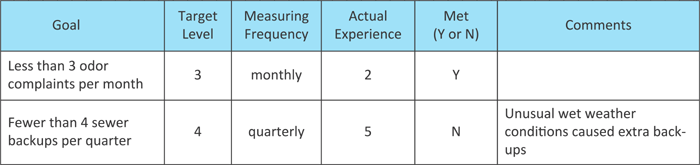
The main point regarding frequency of measuring progress towards meeting goals is that there should be a balance between the amount of resources it takes to get the data (time and money) and measure progress, and the importance of having the data.
An example of goals and tracking to see if goals are met is shown above.
Once this data is examined on a monthly, quarterly, semi-annually, or annual basis, the utility can decide how well they are doing in meeting the goals of the LOS Agreement. There are several responses a utility can take after examining the goals:
- Keep the goal the same
- Raise the goal target level
- Lower the goal target level
- Eliminate the goal entirely
- Revise the goal
If the goal was met, the costs of meeting the goal were within the normal operations, and customers were satisfied with the goal, the goal can be kept the same. oal target levels can be adjusted upward if it appears that the utility can consistently meet a higher level of service without additional cost and customers want this higher level.
Goal target levels can be adjusted downward if the utility will have to hire more staff or otherwise increase costs to meet the goal and the customers would rather have a reduced level of service than pay the higher cost. Adjustments to external goals should be made in the context of customer dialogue, conversation, or feedback. Adjustments to internal goals can be made through discussions between management and operations staff with approval by the governing body.
If the utility determined that the particular goal provided very little benefit to the operations or management of the utility and was not of particular interest to customers, the goal can be eliminated. If the goal was reasonable, but not properly stated or not clearly understood, the goal can be adjusted.
At a minimum, a review of all goals, including consideration of adjusting the goals or target levels should be undertaken on an annual basis. An example of a chart showing goals and progress towards those goals is contained in Appendix B. This example is from Johnson County, Kansas.
We send out monthly reports and quarterly manager reports.
—Stacy Gallick, Johnson County, KS
4.5 Energy Efficiency and Level of Service
Energy efficiency goals should be included in the Level of Service. These goals may be internal goals because customers may not fully understand all of the ramifications of energy usage or a single goal of reducing energy use by some percentage may be set as an external goal. Because energy costs can account for such a large portion of the utility’s overall costs, these goals are particularly important to the operations of the utility.
In order to determine potential costs savings that may result from reducing energy usage, the current energy use and its associated cost must be determined. This is known as developing a baseline. In order to develop this baseline, historical energy use will be needed. At a minimum, one year of energy use data should be collected and analyzed. This data can be collected from an existing accounting system, utility billing records, supervisory control and data acquisition (SCADA) system records, operations and maintenance records, and equipment or motor lists that include horsepower and load information. (As a side note, if a SCADA is in place, add as many data loggers as possible at different phases of the process to determine if any of the equipment has large energy spikes.) Because there may be a lot of data to analyze, graphs and charts can be developed to aid in understanding the data. Along with the historical use data, it is also important to understand the energy rate structure from the energy company. The price of energy and the energy rate structure affect total energy costs. It is also important to understand the hydraulic loading data (flow data) and then compare it to the energy use data. Understanding the rate structure and the link between flow and energy use will help with making energy management decisions.
Once the baseline is established, the utility can monitor energy use to determine how well it is doing on reducing energy use and it associated costs. The utility can also benchmark itself against other utilities of similar size.
The most obvious energy goal is a decrease in overall energy usage as discussed above, but the utility can also set goals related to other aspects of energy usage. For example, the utility can set a goal to switch its fleet vehicles to hybrid cars or reduce overall miles traveled. The utility can set goals to reduce the carbon footprint of the plant or change the type of energy used. Goals specifically related to reduction in greenhouse gas emissions may also be set.
4.6 Communicating the Level of Service Agreement
It is critical for the LOS Agreement and the results of tracking progress towards meeting the level of service goals to be communicated to customers. The communication should focus on the external goals – those goals with direct impacts to customers. The goals and progress towards meeting the goals can be communicated to the customers via newsletters, public meetings, billing inserts, posting in a public place (such as a library or city hall), web site, or other approaches the utility thinks will reach its customers. Publicizing how well you are doing toward delivering the services customers want can be extremely valuable in getting support for the rates and fees you charge. It can also open up a dialog regarding changes that will be needed within the utility to meet goals that customers may want, but may not be possible under the current rate structure. This communication to the public should be at least an annually.
Communicating the Level of Service creates a transparency for the utility which can seem somewhat daunting at first but can lead to very positive outcomes. Customers are much more willing to support what they know and understand than what they don’t know. The more transparent the operation is, the more likely you are to get customer support and remove suspicion and doubt.
Customer communication should also involve a feedback mechanism so that the utility can receive information back from customers regarding how well they think the utility is doing or regarding how important particular goals are. This feedback can be in the form of customer surveys, input at public meetings, phone calls to random customers, focus groups, or other approaches. The feedback can be used in the process of revising goals as discussed in Section 4.4.
We do customer opinion surveys…and include questions related to levels of service.
—Frank Roth, Albuquerque, NM