Remaining Useful Life
All assets will eventually reach the end of their useful life due to continuous use, the passage of time, or a combination of both. Although age of the asset is often used as the primary measurement, many factors affect the useful life of a given asset, such as installation conditions, materials, maintenance, level of usage, weather, and environment. Because of these site-specific characteristics, asset life must be viewed within the context and conditions of that asset and the utility system in which it functions. The exact same asset installed in different states, different cities, or even different parts of the same city may not have the same useful life when considering the above-mentioned factors.
Utility staff can use their experience with the assets and maintenance and replacement records to estimate the remaining useful life for existing assets. Knowledgeable individuals such as operators, managers, maintenance personnel, and engineers all have perspective on the assets in a utility system and can contribute their individual and collective knowledge to estimate how much longer an asset will function at ideal performance.
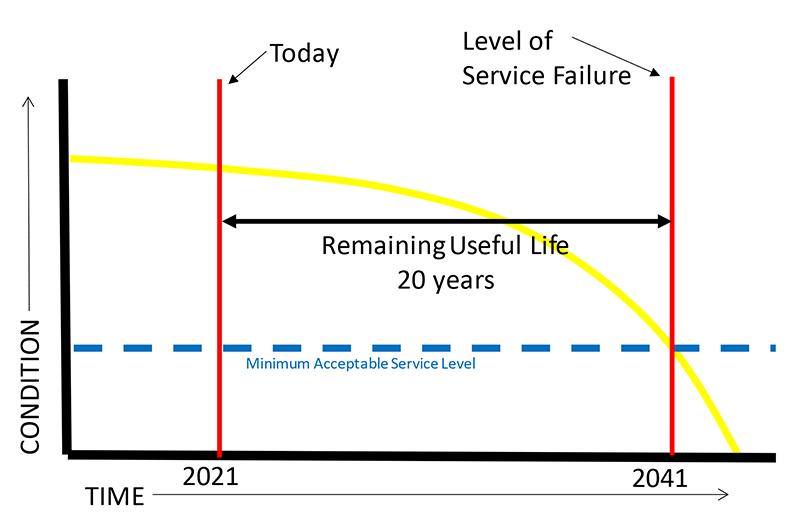
The graph below visualizes the life cycle of an asset. It compares time from installation on the horizontal axis and the condition of the asset on the vertical axis. When the asset is installed, it is at peak condition. As the solid blue line indicates, the condition of the asset deteriorates over time. Using previous experience and knowledge of the asset’s functionality, utility staff can estimate when the asset will no longer perform at ideal standards.
Learn more about the life cycle of assets and how to plan for replacement in the Life-Cycle Costing chapter.