
Calculating Chlorine Dosage, Feed Rate, and Residual – Chlorination Estimator
About this Resource:
Calculating Chlorine Dosage, Feed Rate, and Residual
Chlorine is a useful disinfectant for wastewater treatment and can be introduced in liquid, gas, or solid form. The required chlorine dosage for wastewater treatment depends on a variety of factors including the chlorine demand of the wastewater, the availability of de-chlorination, detention time, and regulatory limits for chlorine residuals in a systems wastewater discharge. To calculate the chlorine demand of your system, a system needs to record their feed rates of chlorine and analyze the residual chlorine in their system after chlorine treatment. The chlorine residual (mg/L) is subtracted from the chlorine dosage (mg/L) to determine the chlorine demand (mg/L). Chlorine residuals can be measured utilizing a simple colorimetry test. De-chlorination is typically required when using chlorine for disinfection due to the hazard chlorine presents to wildlife and public health. Dechlorination is accomplished through a variety of processes, including aeration and sulfur dioxide, which is often favorable, because a 1:1 ratio is often sufficient for dechlorination. A chlorine residual of 0.1 mg/L can be hazardous to fish, and a chlorine residual of 0.3 mg/L can be fatal to fish. Wastewater operators typically determine their required chlorine dosage/ feed rate by continuously testing their chlorine residual using a colorimetry test and adjusting their feed rate as needed. The SWEFC has created a spreadsheet to assist operators in estimating their required feed rate, required chlorine dosage, and likely chlorine residual.
Chlorination Estimator
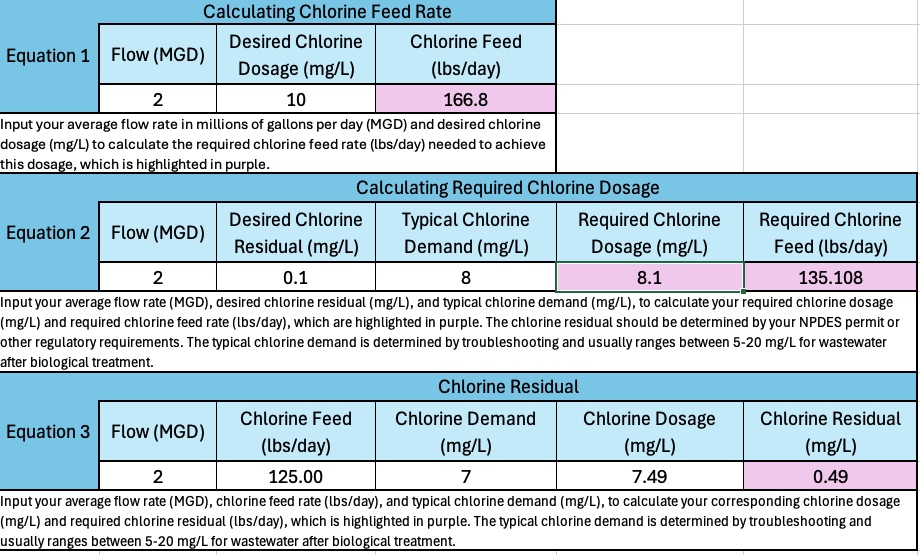
The Chlorination Estimator is a simple excel tool that operators can use to calculate their chlorine needs. By inputing a few simple wastewater parameters operators can calculate the chlorine feed rate needed to achieve a desired chlorine dosage, the required chlorine dosage required based on the desired chlorine residual and known chlorine demand, and likely chlorine residual.
Download the Chlorine Estimator Here
Download Calculating Chlorine Dosage, Feed Rate, and Residual Here